Simulated Forex Trading Accounts
What is a Simulated Forex Trading Account?
A simulated forex trading account, also known as a demo account, is a practice account provided by a broker or trading platform. It allows a trader to place trades in real or semi-real market conditions using virtual money (free play money) instead of real money. The price feeds and charts are usually live or near live, the platform functions are identical or very similar to a real-money account, and the trader can open and close positions as if actual money were at risk.
That setup makes demo accounts attractive to beginners, to traders trying out a new broker, and to anyone who wants to practice a new trading strategy. Simulated forex accounts offer a way to learn without paying tuition to the market. A new trader can study order tickets, lot sizes, stop losses, take profit levels, margin requirements, platform layout, and much more without losing real money to mistakes and misunderstandings. The demo account is a controlled environment where you can learn mechanics and test decisions. A demo account is useful because it removes financial damage while you are still figuring out platform features or the basics of a new strategy.
With that said, it is important to always remember that a simulated forex trading account is not a real-money account, and there will be notable differences between the two, both practically and from a psychological perspective. No not treat profitable demo results as proof that you have mastered live trading and is ready to put big money on the line. In simple terms, a demo account is more like a flight simulator. It can teach controls and procedures, and get you used to certain reactions. It cannot fully recreate what happens when the aircraft is real and the consequences are immense.
The usual description is that demo and live accounts are the same except for the money. In practice, that “except” does a lot of heavy lifting. A real-money account introduces consequences. Once consequence appears, decision-making changes. Traders second guess entries, close trades too early out of fear, or keep positions open too long due to greed. They widen stops they promised not to move. They feel a losing trade emotionally, not just on the screen.
There is a discipline gap between demo trading and live trading, and you need to be aware of this. In demo, traders often behave like explorers. In live trading, they behave like owners. Every mistake now feels costly, and that feeling changes behavior faster than most people expect. This is one of the reasons why a trader can be profitable for three months in demo and then struggle immediately in live conditions. The transition is not just financial. It is psychological and operational. A demo account teaches process in a low-stakes environment. A live account tests whether that process survives contact with true financial risk. That is the real difference.
Execution can differ as well. In a live account, you strategy will be up against real spreads, real liquidity conditions, possible slippage, and all the ordinary friction that comes with actual market participation. Demo accounts may reflect market pricing, but they do not always reproduce the full picture. Exactly how true the conditions are depend on the broker and platform. Some demo accounts will for instance be completely devoid of slippage.
A simulated forex trading account is useful, but only within its limits. It is good for things such as learning platform mechanics, rehearsing a trading plan, and practicing basic risk management. It is poor at replicating emotional pressure and real execution friction. That is why demo success should be treated as an indication and not as proof. Profitable trading in a demo account may show that a trader understands the basic process and that the strategy works well in ideal market conditions without slippage. It does not prove the trader and the strategy will perform well under live conditions.
Use the demo account environment to learn, test, record, and evaluate. Work solid risk-management routines into your backbone. Treat your demo account seriously enough to build good habits. A demo account can shorten the learning curve and make the process less costly.

Why Brokers Offer Demo Accounts
Brokers do not offer demo accounts out of pure generosity. The practical reason is simple: demo accounts are one of the cheapest ways to acquire future customers. A person who opens a demo account is already partway down the funnel, but it does not feel like a big step when you can open a demo account for free and use it without making a deposit.
A trader who opens a demo account have chosen a broker, submitted at least some contact details, downloaded a platform or logged into a web terminal, and started interacting with the interface. From the broker’s point of view, that person a likely candidate for conversion into a funded account.
This does not mean that demo accounts are offered as a form of manipulation. As we have mentioned earlier, demo accounts come with many benefits for the trader. When they closely mimic the live trading environment, they are also a great way to find out if this broker and platform is suitable for your preferences and needs.
Trading platforms can be confusing at first, and even basic tasks such as placing a market order, adjusting a stop loss, or reading margin usage are not obvious to someone new. A demo account reduces that friction. It helps users learn where things are and how the system behaves, and see if they like the interface.
That said, the business incentive should stay in view. A broker benefits when a trader becomes comfortable enough to move from demo to live trading. So while demo accounts are useful, they also serve as onboarding tools. The goal, from the broker’s side, is not simply education. It is familiarity, confidence, and eventually a deposit. This does not make demo accounts bad. It just means the trader should understand the arrangement clearly. The demo is a tool for the trader, but it is also part of the broker’s customer acquisition model.
Why Should I Use a Demo Account?
Evaluating the Broker and Platform
Even though simulated forex trading and live-trading aren´t identical, a high-quality demo account will still give you a pretty good idea of what it would be like to use this broker and trading platform for your particular trading strategy. Use the demo account to find out if this broker and platform is suitable for you and your strategy before you have made any first deposit. It is much easier to walk away from an unsuitable broker and/or platform before you have transferred any money.
Learning Platform Mechanics
A demo account can be a great way to learn platform mechanics. This sounds dull, but many beginners make preventable mistakes that erode their account balance, because they are so eager to start live-trading that they skip the demo trading step. A trader needs to know how the order panel works, how to set position size, how stop losses and take profit orders are entered, how pending orders differ from market execution, and where to check spread, equity, free margin, and used margin. These are not advanced topics, but they matter immediately. Demo trading is useful because mistakes will only cost you free play-money. A trader can place the wrong order, close the wrong position, or accidentally oversize a trade and then learn from it without losing actual money. That is valuable. It is better to make those errors in a simulated account than in a funded one with leverage. At this stage, the demo account is doing exactly what it should. It gives the trader procedural competence before real financial risk is introduced.
Testing a Trading Plan
A demo account is also useful for testing the basics of a trading plan, within the constrains of the demo environment. This means more than asking, “Did I make money last week.” It means checking whether a method can be followed consistently and whether the results make sense over a decent sample of trades. A trader can use the demo to answer practical questions. Does the setup appear often enough to matter? Do the stop placements make sense relative to normal volatility? Is the reward to risk ratio realistic? Do I have a strong urge to take trades outside the rules of my trading plan?
All this matters because many beginners think they need a brand new strategy or a bunch of paid tools/subscriptions, when the real issue is that they have never followed any trading strategy properly for long enough to truly evaluate and adjust it. A demo account gives room to test without the pressure of immediate financial profit or loss. Used well, the demo account becomes a rehearsal space for discipline and evaluation.
Practicing Risk Management
Risk management is another area where demo accounts can help, though with a limit. A trader can practice setting fixed risk per trade, calculate position sizes, and see how losing streaks affect account balance over time. They can observe how quickly an account changes when risk is too large, and how much more stable it looks when risk is capped at one percent or less per trade. This is useful because risk management is easy to talk about and difficult to stick to. In a demo account, traders can run the numbers through repeated experience. They can see the difference between a method with decent discipline and one where decisions are chaotic and based on gut feeling or online chatter.
The catch is that demo risk management is still theoretical, since no real money is on the line. It teaches the arithmetic and the structure. You might still fail to show restraint when the money becomes real. As a training step for risk management, a simulated forex trading account has value.
Be Aware of the Pitfalls
No Real Emotional Pressure
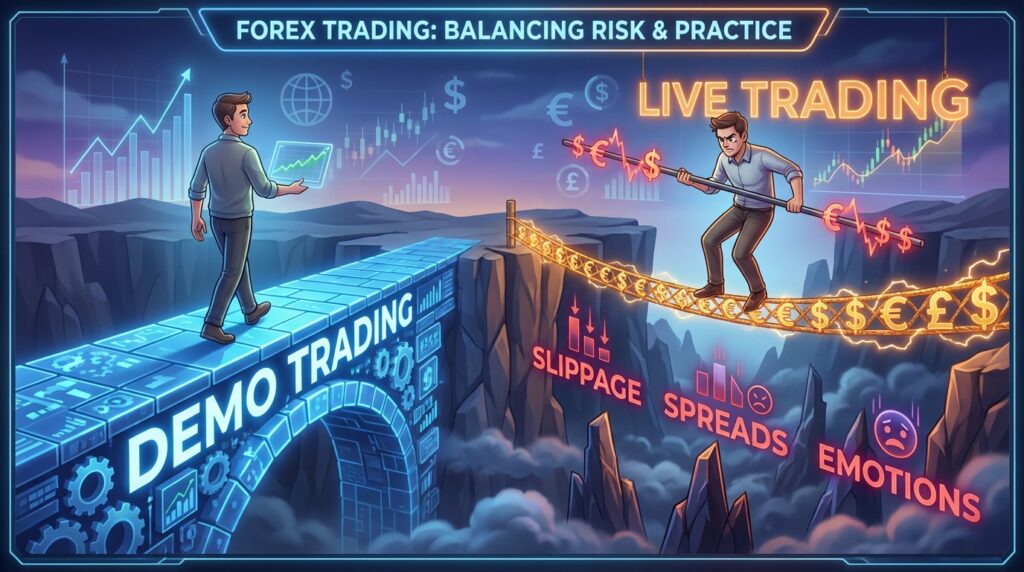
The biggest weakness of demo trading is that the money is not real. That sounds obvious, but it changes almost everything. When the funds are free play-money, emotions such as fear, greed, and shame do not really come into play. A trader may hold through drawdowns because nothing serious is being lost. They may let winning trades run because they do not feel the usual urge to lock in gains. They may place oversized trades because the account can be reset in a minute if things go wrong. They do not experience shame or deep disappointment in themselves after a big loss, and will therefore not succumb to revenge trading.
This lack of strong emotions creates a false sense of skill. It is easy to be very calm, patient, and systematic in demo trading simply because there is no real consequence attached to any decision. Once real money is involved, that same trader may cut winners early, move stops, revenge trade after a loss, or hesitate on valid entries. That is a key limitation of every demo account. It can simulate price movements, but it cannot simulate genuine emotional exposure. A trader who ignores that gap will often be confused when excellent demo performance turns into poor live performance. On paper, the strategy may not have changed at all, but the trader´s implementation of it did.
Idealized Execution and Market Conditions
Demo accounts can create a distorted view of execution quality. Many traders assume the platform behavior they see in demo mode will match the live account exactly, and that assumption is risky. Many demo accounts display an idealized version of market conditions, where fills appear smoother and slippage may look smaller or be completely absent. Partial fills and execution delays may be less noticeable, and fast market conditions often feel more forgiving in simulation than they do in live trading, especially around major economic releases or sudden spikes in volatility.
This matters, because some trading strategies only generate profits over time if execution is clean. A scalping method that depends on tiny moves may appear profitable in demo and then fail in a live account once spread widening, slippage, and real market friction are introduced.
Not every broker makes demo conditions unrealistically generous, but the structural point remains. Simulated execution is not the same thing as live execution. It can be close, sometimes very close, but not identical. And it can be difficult for the trader to know how close to the real-deal this particular demo account is kept. A trader should therefore treat all demo results as provisional. They are useful, but they are not final proof of how the method behaves under real conditions. When you transition to live-money trading, use minimal position sizes in the beginning, even if that means sticking very far below the max 1% rule for position sizing. This can help you spot discrepancies without losing a lot of money in the process.
Bad Habits Form Easily
Demo accounts can encourage sloppy behavior because no real money is on the line and execution conditions are better than the real thing. A trader may overtrade because of boredom and double position size after a loss just to see what happens. They may ignore their plan and start taking random trades, and they may leave positions unmanaged because there is no real pain attached to negligence. It is even easy to convince yourself that you are actually doing a good thing, that you are learning new things by playing around a lot in demo mode.
Unfortunately, habits formed in demo mode does not necessarily stay inside the demo environment. They often transfer into live trading, especially during times of stress when you are more likely to run on autopilot. This is when you will discovers that bad habits practiced in a safe environment are still bad habits.
This is one reason demo trading sometimes fails as a training tool. The problem is not the account itself, the problem is that many users do not treat it seriously. They use it as entertainment, but still expect it to produce professional discipline. That is a poor bargain. A demo account should be used with the rules you intend to follow in live markets. Otherwise, it becomes a rehearsal ground for the habits that will damage your real-money account later.
How to Use a Demo Account Properly
Realistic Conditions
A demo account works better when it resembles the conditions the trader expects to face later. Among other things, that means choosing a virtual balance close to the amount you may realistically fund in a live account, not picking a huge demo balance just because it is available. Someone planning to start live with $500 should not practice with a $100,000 demo balance and imagine the lessons will transfer neatly. Position sizing, leverage habits, and tolerance for drawdown will all be distorted.
Trade Your Strategy Only
In addition to a realistic account balance, realism also means trading the same instruments, time frames, and session hours you intend to trade live. If you only plan to trade London session majors, then the demo should be built around that routine, not around random all-day clicking in whatever market is moving. The closer the simulation is to your actual trading strategy for real-money, the more useful the demo mode practice hours become.
A common mistake in demo accounts is constant switching. Traders move from breakout systems to scalping, then to trend following, then to news trading, all in the same week. This creates activity, not learning. You might tell yourself that you are trying out different things to learn, but what are you learning exactly? How are you evaluating these different strategies?
A better approach is to select one method and stick to it long enough to gather meaningful evidence. That means defining things such as entry, exit, stop placement, and risk rules clearly, then following them over a reasonable number of trades. Without that consistency, the trader cannot tell whether the method works, whether execution is the issue, or whether the real problem is lack of discipline.
A demo account is most useful when it reduces variables. One method, a single market focus, and one risk management plan. That is how a trader gets information that can actually be used.
Track and Evaluate the Results
A time-consuming but valuable part of demo account trading is to keep and analyze records.That means writing down the reason for each trade, entry and exit levels, risk size, result, and whether the trade followed the rules. Screenshots help as well. Over time, this creates a record that can be reviewed for patterns. On some platforms, software is available to help you along, and some of the parameters can be entered automatically.
A trader will often discover that the problem is not the setup itself but repeated trader behavior around it. Maybe good trades are skipped after losses, rules are bent late in the session, and risk increases when frustration rises. These patterns are hard to spot from memory and easier to see in a journal. Tracking results also prevents demo trading from becoming vague self-flattery. It forces the trader to look at actual process instead of a general feeling that things are going well.
Starting this process in demo mode will also make you well prepared to do it as you transition into real-money trading. If you are too lazy to do it in the simulated environment, you will probably come up with a reason to skip it for your live trading as well.
When to Move From Demo to Live Trading
The move from demo to live trading should not happen because the trader feels excited or bored. It should happen because they have shown a degree of consistency under self-imposed rules. That does not mean they need perfection. It means they should understand their method, follow it with reasonable discipline, size positions correctly, and have enough records to know how the approach behaves over time. Even then, the first live account should be small. The purpose of that account is not aggressive profit, it is adaptation and evaluation. The trader needs to see how their behavior changes when money is real, and that lesson is cheaper if the account size is modest. They also need to spot how the live trading environment is different from the demo environment, e.g. when it comes to slippage.
This stage often surprises people. A trader may find that their live discipline is much weaker than demo discipline. That is not failure. It is information. The account is now showing the difference between theoretical control and real emotional control. Moving live too early, and starting big, usually damages confidence and can burn through your bankroll. Moving live in a small, controlled way gives the trader a chance to adjust without severe financial and emotional punishment.
Simulated Forex Trading Account Red Flags
Below, we will look at a few examples of demo account red flags. Some shady brokers (and outright scammers) will reveal warning signals about themselves even at this early stage. When you look at the terms and conditions for the simulated forex trading account, do so with a critical eye. Sometimes, the best course of action is simply to walk away.
No demo account
High-quality brokers that know they have something great to offer, including access to a top-notch trading platform and excellent terms and conditions for trading, are typically very eager to let you try all this out in a demo environment. If a broker does not offer a demo account, that is cause for concern. It does not automatically mean that the broker is bad or the trading platform shoddy, but one needs to paus and ask why this particular broker is going against the grain and refusing to provide prospective clients with a free demo account.
There are so many good and reputable brokers around nowadays that will happily give you a demo account, so why pick one that wont?
Access to demo account requires a first deposit
One of the main ideas behind the demo account is to give you a chance to properly evaluate the broker and the trading platform before you make any deposit. Reputable brokers understand that even a setup that is ideal for one trader and trading strategy can be all kinds of wrong for another trader and trading plan.
When a broker forces you to make your first deposit to get access to the demo account, they are showing low confidence in their product. They want to lock you in a bit, before you even get a chance to look around for yourself. This is concerning even if the minimum deposit is low.
Within this category, we find some of the more low-effort broker scams, where there is not even a platform to explore in demo mode. The scammer just want to collect a bunch of first deposits from people and disappear with the money.
Credit card required upfront
Some brokers do not ask for a first deposit, but claim that you must have a credit card on file with them to access demo mode. But why? Free demo accounts don’t need billing. And it is not as if your demo account is a hotel rome where you might smash the TV or steal the bathrobe.
Handing over your credit card information, or similar, can open the gate for unauthorized charges or undue nudging tactics.
Examples of why a broker can be so eager to get your credit card on file:
- “One-click” deposit nudging. They say: “Just activate your account—it’s instant”. Giving you a single button to push to fund your account removes friction and makes you more likely to act impulsively instead of thinking.
- They can suddenly stop the demo process and ask your to “verify” your card or your identity by allowing a small charge. And you might do it, even though it was not your plan to make any deposit this early in the evaluation process.
- With your credit card or other payment details on file, it can be easier to push your to a first deposit using various time-sensitive promotional campaigns or nudges. Market opportunity is happening NOW! JPY is moving – enter today! Claim your big, special welcome bonus within the next 2 minutes!
- Last but not least, a shady broker can use your payment info to make unauthorized or unclear charges. Maybe you did push that “okay” button last night that permitted the $1 verification fee? Maybe you somehow aggreed to the $50 platform fee in the fine print when you signed up for the demo account?
Stay away from brokers that require you to hand over payment information to open a free demo account. It is not the type of broker you want to trust your money and assets with.
Full registration / KYC / AML information required for a demo account
The demo account is only for play-money trading. So why treat you as if you were depositing, risking, and withdrawing real money?
The norm is to allow prospective clients to open a demo account with minimal information, e.g. your name and a valid email address or phone number. If a broker forces you to jump through hoops and hand over all kinds of personal information, you need to ask yourself why. Is this really a legal requirement? If you are curious, check with the applicable financial authority. If you are not, simply walk away and find a broker that does not have these demands.
Best case scenario (or, least worse), the broker is just being a bit manipulative. They know you are less likely to step away and cut bait if you have put time and effort into the full registration, KYC and AML process. Still, this kind a manipulation is not something you want to see in a broker.
Worst case scenario, the broker is eager to get their hands on your personal data for identity theft purposes. By the time you realise that this broker is shady, or an outright fraudster, they already have copies of your ID/passport, utility bills, bank statements, selfie, and so on. Everything you use to prove your identity and residency, a fraudster can use in the same way. Do not share this type of information with any broker until you have done the full broker due diligence (including license verification), tested the demo environment, and are ready for live money trading.
Very limited demo time
You need time to fully evaluate the broker, the platform, your strategy, and your risk management plan. Many serious brokers will give you 30 days to start with, and a simple message to customer service will extend it (no strings attached). They understand that inexperienced traders are most likely doing this on the side, while juggling a dayjob, studies, family obligations, and more. It is not reasonable to assume you will be able to clear everything out of the way and lock down for 48 hours of intense trading because a stingy broker refuse to give your more time. Also, a 48 hour test window does not allow you to experience how markets change over time, e.g depending on time of the week, after holidays, when sudden news drop, and so on.
Giving your a very limited time with the demo account is a pressure tactic, to push you into depositing quicker. It can also be a sign that the broker does not want you to have enough time to make a deep evaluation.
Very limited demo account balance
The broker is giving your play-money, so why are they being stingy? While we recommend your set the account balance in a realistic fashion, that should be your choice, and you should also be able to replenish the account if you need a new chance to practise after doing a beginner mistake and wiping out the balance.
Just as with time, a broker that is stingy with play-money is a red flag. They want you to quit demo evaluation and go straight to funding and live-money trading, even though you are not ready for it. They care more about getting their hands on your first deposit than about your long-term viability as a real-money trader. Reputable brokers still want to make money, but they are in it for the long haul, and it is great for them if you become a long-term profitable trader rather than someone who quickly burn through their first deposit and quits.
Features locked or “crippled” demo
It is not necessarily a red flag if a certain high-value feature is blocked in demo mode. The broker might not want everyone and their grandma to sing up for free and gain acess to the valuable news feed that is intended as a perk for live trading customers.
But there must be a balance here, and some demo accounts are simply too crippled to provide a useful simulation of what it would be like to use this broker and platform. Instruments are limited, tools are missing, you can´t simulate leveraged trades, and so on. Something is fishy and it is best to stay away.
Unrealistic demo performance (too good)
As we have talked about before, it is not unsual for a demo environment to be a little bit too good, e.g. when it comes to slippage. That is not a red flag in itself, just something you need to be aware of.
There are, however, brokers who deliberately create a demo environment where you will feel like the best trader in the world. You are constantly winning big trades, margin rules don´t apply to you, and your gut feeling is spot on. If you test out some service provided by the broker (or an affiliate), such as a trade signal service, it will performe miracles. The master traders you follow on the copy trading platform are finance geniouses and the automated trading bots are true money-making machines.
Be suspicious when things go too well. The broker might be stroking your ego to make you more likely to deposit and start trading big.
Costs are not transparent in demo mode
An important part of demo practise is to see how the costs show up for your particular trading strategy with this particular broker. If costs are not transparent and correct in the simulated forex trading environment, you lose a very important component of your demo time, and whatever data you gather will be less useful. It can also be a warning sign that the broker is deliberately opaque when it comes to live trading costs as well, and that is definitely not something you want to deal with when real money is on the line.
What you want is a demo environment where spreads are visible, any commissions are shown clearly, swap/overnight fees are included, and so on. The real costs should make an impact on your account balance and give you a realistic view of what real-money trading would look like with this broker.
Hard pressure sales tactics during demo period
It is a really bad sign if the broker becomes a pest during the demo period. Yes, even reputable brokers will try to make it easy for you to switch over to live-trading, and they will probably dangle some offers in front of you now and then. But they will not pair you with an “account manager” that turns into an insuffarable bully; one who is now calling and messaging you in a frenzied way to push you into depositing. High-pressure tactics are strongly associated with fraudulent brokers, and brokers licensed by reputable financial authorities are typically barred from behaving like this (especially towards retail clients).
Poor or no support even in demo phase
Some shoddy brokers and outright fraudsters can´t even put their best foot forward during the demo period. It is always a good idea to interact with the support before you open a demo account and during the demo period. Pay attention to how you are treated and how the support works. Is it just a sales funnel where the goal is always to push you into depositing? Or are you getting quick, helpful and knowledgeable replies? Is the support staffed 24/7, or at least when you are most likely to trade? Or are you being sent on to an clunky support bot, or to a call centre where someone reads from a script and provides vague or misleading answers?