Forex PAMM Accounts
Plenty of traders reach the same point sooner or later. They like the foreign exchange market, they understand the basic mechanics, and they know there is money to be made, but they do not have the time, discipline, or edge to trade it themselves every day. That gap is where Forex PAMM accounts sit. A PAMM account, short for Percent Allocation Management Module, is a structure that lets one trader manage a pooled account while multiple investors allocate capital to that trader’s strategy. The money manager executes trades. Investors supply capital. The broker handles the accounting, allocation, settlement, and reporting.
In plain English, a PAMM account is a managed forex account with automatic profit and loss distribution. If the manager makes money, each investor receives a share based on how much of the pooled capital they contributed. If the manager loses money, the losses are allocated the same way. Nobody needs to calculate it by hand. The platform does the math, and that alone removes a lot of friction.
The appeal is obvious. A capable trader gets access to more capital without opening a hedge fund. An investor gets exposure to active forex trading without placing trades personally. In theory, that sounds neat. In practice, it only works well long-term when the structure is transparent and the people inside it are worth trusting. That last part matters more than the marketing. PAMM accounts are often pitched as an easy route to forex passive income. That phrase sells well because it sounds tidy, but reality is less tidy.
The real question is not whether PAMM accounts can work. They can. The question is how they work, what they cost, where the traps are, and how to evaluate the many different offers available. It is also a good idea to look at the other alternatives, since putting your money in a PAMM account is definitely not the only way to shoot for a passive or semi-passive forex income.
A PAMM account is not a magic shell around a trading strategy. It does not improve a bad strategy. It does not turn an erratic trader into a stable one. It does not remove slippage, spread costs, liquidity constraints, or the very boring truth that profitable foreign exchange trading is hard. Many beginners hear “managed forex account” and think the management itself is the edge. It is not. The edge, if there is one, sits in the manager’s process, discipline, and risk control. The PAMM structure is just the plumbing. Good plumbing matters, but nobody got rich because the pipes were professional.
Before you sign up for anything, it is really important to understand the terms and conditions. A PAMM allocation is not a bond coupon and not a savings product. It is exposure to (usually heavily leveraged) forex trading managed by someone else. This can also go wrong in ways that are faster and uglier than many passive investors expect. The attraction is convenience and access. The cost is that control moves upstream, away from your individual trade decisions and into your broker selection and manager analysis.
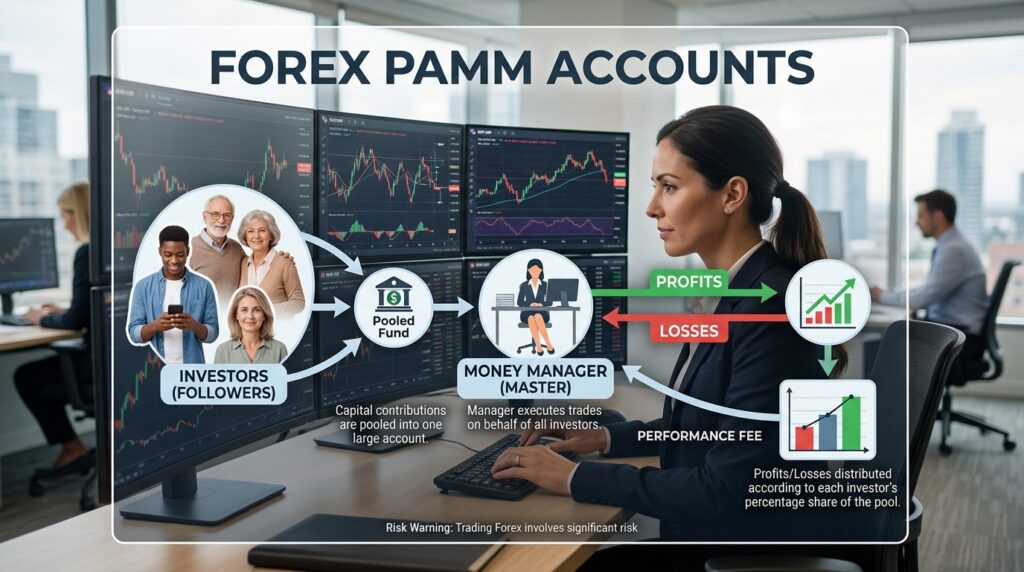
How PAMM Accounts Work
A PAMM structure rests on three parties.
- The broker provides the platform, custody, reporting, and execution environment.
- The money manager trades the account according to a stated strategy, or at least according to whatever strategy they actually use once live money is on the line.
- The investors allocate funds to that manager and each investor receives a proportional share of the account’s performance.
The easiest way to understand the mechanics is to picture a single trading account with multiple owners behind it. The manager usually (but not always) contributes some of their own capital to the account. Investors then add their funds. The broker’s system tracks each participant’s percentage share of the pool.
Example: Say a manager starts with $10,000 of personal capital. Two investors add $20,000 and $70,000, respectively. The total pool becomes $100,000. The manager owns 10 percent of the account, the first investor owns 20 percent, and the second investor 70 percent. If the account gains 8 percent over the next period, the gross profit is $8,000. That gain is allocated according to each participant’s share. If the account loses 8 percent, the loss is distributed the same way. 10% of $8,000 is $800. 20% is $1,600. 70% is $5,600.
This ratio based structure is what makes Percent Allocation Management Module (PAMM) a useful label rather than just broker jargon. The manager is not opening separate trades in ten different retail accounts and hoping everything stays synchronized. One strategy is traded in the pooled account, and the results are split by ownership percentage.
The settlement process
The settlement process is normally automated. Performance fees, if charged, are deducted according to the broker’s rules and the manager’s fee agreement. The remaining profit or loss is then credited to each investor. This matters because it creates a layer of operational control the manager does not directly own.
In a standard PAMM arrangement, the manager trades, but does not have the ability to simply withdraw investor funds into a private account, because the money remains within the broker’s system. That does not remove all embezzlement risk, but it does put up some barriers. And investors definitely get a cleaner structure than the “send me your login and trust me” nonsense that has become so prominent in the world of online forex trading. The PAMM account formalizes the relationship between the investor, the manager, and the broker.
Scaling
A manager can run one strategy across a growing pool without asking every investor to mirror positions manually.
Key Benefits for Investors
Passive participation
The first benefit is obvious and also the most overused in marketing: passive participation. A PAMM account allows an investor to access an active forex strategy without spending hours in front of a screen. For people who understand markets but do not want trading to become a second job, that has real value. The investor does not need to study every central bank speech, monitor every nonfarm payroll release, or sit through the sort of intraday chart chop that makes many retail traders question their life choices.
Specialization
The second benefit is access to specialization. Not every trader is built for the same style. Some managers trade short term momentum. Some focus on swing setups around macro themes. Others may run carry based systems or event driven approaches. A PAMM structure allows an investor to choose exposure to strategies that would be difficult for themselves to reproduce because they don´t have the same experience, capital, or infrastructure at their disposal.
Diversification
Diversification inside the PAMM model is another real advantage, at least when done properly. An investor does not have to commit all capital to one manager. Funds can be split across different managed forex accounts with different trading styles, different time horizons, and different risk profiles. That does not remove risk, but it can reduce the risk that one manager’s bad month becomes the whole story
Low barriers
There is also a relatively low barrier to entry in many cases. Some PAMM brokers allow small minimum deposits, which means an investor can test the structure without risking a big amount of money. This can be especially appealing for strategies that are difficult to carry out on a shoe-string budget. By pooling resources, investors can create a bigger total account.
Easy withdrawals
With informal pooling schemes (not PAMM), the person trading usually also controls withdrawals from the account, which of course is a big risk. With PAMM, you can pick a broker where you retain not only formal ownership but actual practical control of your funds, as you are able with withdraw the amount directly from the broker. This also means that the broker, and not the trader, is in charge of approving and processing withdrawal requests.
It is strongly recommended to pick a broker licensed by a strict financial authority that requires client funds to be kept separate form company funds, and where the terms and conditions of the PAMM account stipulate that you can withdraw according to the broker’s terms without needing the manager’s permission. That is a major difference from informal pooling schemes where the person trading also controls the account. Any structure that reduces the number of ways capital can disappear without recourse is to be preferred.
Understanding the background
The PAMM account is a relative new invention. They were first introduced in the early 2000s and primarily used in Russia.
In the early 2000s, Russia had a rapidly growing retail forex market, spurred by a wave of currency brokers who had emerged following the collapse of the Soviet Union little more than a decade prior. Many professional fx traders began taking on clients who were eager to participate in currency trading but lacked the expertise or time to trade effectively on their own. The introduction of the PAMM account allowed these professional traders to more easily manage many clients, and the system would automatically allocate profits and losses proportionally to each investor’s contribution. This automation reduced the potential for errors and disputes, and increased transparency.
In Russia, pioneering companies such as Alpari and Forex MMCIS developed PAMM platforms that allowed investors to track the performance of the professional traders in real-time, giving investors a sense of transparency and accountability that helped build trust in the system.
From Russia, PAMM accounts gradually spread to other countries, especially in Asia and Europe. Today, PAMM accounts are available in many parts of the world and with many different brokers, but Russia and the other CIS countries remain the largest and most mature market for PAMM accounts. In the United States, the development of PAMM has been largely blocked by the strict regulatory environment. Instead, similar structures exist under the LPOA framework, which allows professional traders to manage client accounts legally while adhering to U.S. regulations.
Evaluating a PAMM Broker
An unsuitable broker can ruin an otherwise good trading strategy, and a dishonest broker can ruin everyone. It is therefore important to put effort into evaluating which broker you pick for your PAMM account.
License and jurisdiction
The first filter is regulation and licensing. A PAMM broker should operate under a recognized regulatory framework, and the investor should know exactly which entity holds the license. This is where many people get lazy. They see a badge on a homepage, assume the job is done, and move straight to scrolling performance tables. That is backwards. The broker is the custodian, the operator of the PAMM technology, and the gatekeeper for deposits, withdrawals, and dispute handling. If the legal entity is weak, the platform quality does not matter much.
If you pick a broker outside your jurisdiction, you introduce jurisdictional complexity, and your legal protection can be reduced even if the broker is licensed by a reputable financial authority. This also means that you need to be eagle-eyed when you sign up, because some global broker brands will lure you in with campaign materials showcasing a license from your jurisdiction, and then skillfully nudge you towards signing up with a subsidiary based in an offshore paradise nation where trader protection rules are weak or not enforced.
Before you proceed, you should also check the rules regarding governmental investor protection in your jurisdiction. Some schemes cover PAMM accounts while other do not, and it is important to know where you sit.
Top-tier regulation and staying within your own jurisdiction is not a guarantee of safety, but it is a better starting point than an offshore license from a jurisdiction where the financial authority seems to exist mainly to receive cash from brokers, print certificates, and avoid phone calls. Under a top-tier financial authority such as SEC, UK FCA, or ASIC, supervision is more serious, the compliance burden is higher, reporting expectations are clearer, and the legal route for complaints is more accessible for retail traders and investors.
A broker that is suitable for the strategy
Execution quality matters more than many investors realize. A manager trading a medium frequency or short term strategy can be wrecked by wide spreads, bad slippage, delayed execution, or unstable platform infrastructure. Investors tend to focus on the chart and forget the plumbing. But in forex, the plumbing can quietly eat the strategy alive, especially if conditions get tough. If the strategy is tested by unusually harsh conditions in the future, when have already committed, the suitability of the broker can make or break it. A PAMM broker that is suitable for one strategy can be unsuitable for another, so pick with care.
PAMM performance transparency
After regulation, the next issue is performance transparency. A serious PAMM broker should provide verified account statistics with enough detail to evaluate risk, not just profit. Return on investment looks nice on a leaderboard, but it means almost nothing by itself. Investors need to see details such as maximum drawdown, age of account, deposit history, fee terms, trading frequency, and preferably some record of how the account behaved during bad periods. If the platform highlights gain and hides pain, that tells you something already.
Deposits and withdrawals
Deposit and withdrawal procedures deserve boring attention. A broker should state clearly how funds move, how long withdrawals take, what fees apply, and whether there are lock up periods or internal transfer rules. Ambiguity here is cause for concern and will usually means the stress test will happen after you want your money back.
Interface
Platform design matters, though not in the cosmetic sense. Investors should be able to monitor allocations, fee accrual, historical performance, and changes in manager conditions without needing to beg customer support for screenshots. Basic operational transparency is not a premium feature. It is the minimum.
A decent broker does not need to look exciting. In fact, the more a PAMM broker resembles a casino lobby, the more cautious an investor should become. Forex already has enough moving parts. The broker should reduce operational risk, not add theater to it.
Broker incentives
Some PAMM brokers are fairly neutral technology providers who make their money in the conventional way, typically through a combination of spreads and commissions, and some of them are also (properly regulated) market makers. Others make it a bit too easy for high risk managers to climb rankings because high turnover and flashy returns attract more deposits and that is the focus for these brokers. A ranking table full of young accounts with absurd monthly gains is not a sign of healthy opportunity; it is a sign that the platform rewards spectacle and that the main aim here is to bring in as many first-deposits as possible.
Understanding the Fees and Costs
PAMM costs and fees are usually less confusing once you strip out the sales language. It is very important that you fully understand the entire cost and fee structure before you sign up and make a deposit. Below, we will go through a few examples of fees that commonly show up in this structure for PAMM accounts.
Performance fee
This is the manager’s share of net profits, charged only when the account makes money for the investor. Many PAMM setups use a high water mark, which means the manager only earns a new performance fee after prior losses have been recovered. If an investor’s allocation falls from $10,000 to $8,000 and later climbs back to $10,000, there should be no fresh performance fee on that recovery alone. The fee should only apply to gains above the previous peak. That rule matters because without it, investors can end up paying twice for the same recovery. Check the fine print to find out if your broker has this rule for PAMM accounts or not.
Management fee
Some structures also include a management fee, and it is usually a charge for running the account regardless of performance. This is more common in traditional asset management than in retail forex, but it does appear in some PAMM models. Investors should be cautious here. A management fee layered on top of a performance fee can make mediocre trading significantly more profitable for the manager than for the client.
Brokerage and execution costs
Spreads, commissions, swaps, leverage costs, and slippage all affect the gross result before the investor sees the final number. A manager may appear profitable on paper, but if the strategy depends on very fine margins, broker and execution costs can erode the edge. Also check what the broker will charge you for deposits and withdrawals through your preferred method.
Fees should be transparent, simple to calculate, and suitable for the manager’s stated style. A scalping strategy based on hundreds of minimal positions should not be burdened with a big fixed commission on each position, and so on.
Analyzing a Money Manager Beyond ROI
Most investors start by looking at total return. That is understandable but also a bad habit. In PAMM investing, raw ROI is one of the least useful numbers and it should never be viewed alone. Plenty of terrible managers can produce a beautiful return figure for a while. Some of them do it right up until the account detonates, because they are taking outsized risks and running a strategy that works fine for a short period of time until conditions change (and they always do).
Drawdown
Maximum drawdown is a good starting point for your analysis. Drawdown shows how much the account has fallen from peak to trough during the reporting period. This matters because it gives a rough picture of the pain required to produce the return. A manager with 80 percent annual gain and 65 percent drawdown is not necessarily impressive. They may just be one ugly week away from destroying the account. A lower return with controlled drawdown is often the more investable profile, especially for anyone treating PAMM as part of a wider portfolio rather than a weekend bet.
Equity curve
The equity curve tells another story that headline ROI often hides. Steady growth suggests discipline, even if it is not exciting. A jagged curve with vertical bursts can point to oversized positions, recovery trading, martingale behavior, or plain luck. Investors do not need to display a perfectly smooth line, because real trading is messy, but you should be suspicious of performance that signals poor risk management.
Trading strategy
The manager’s strategy is, of course, important. Pick a strategy that suits your own preferences when it comes to factors such as time-horizon and risk-willingness.
How the strategy is written down and explained is also worth noting, because vagueness is a warning sign. A manager should be able to explain the broad framework in simple and conventional terms. Is the strategy trend following, mean reversion, macro discretionary, news based, or short term technical trading? What time horizon does it operate on? What instruments are traded? What is the expected drawdown range? If the explanation is vague, mystical, or stuffed with phrases like “secret algorithm” it is best to keep your money to yourself.
Manager conduct
Investors should continuously look for behavioral clues when evaluating the manager. Does the manager update investors in a calm, consistent way? Do they explain drawdowns without blaming brokers, manipulation, moon phases, conspiracies, and a curse? Professional communication does not guarantee professional trading, but reckless communication often travels with reckless trading.
It also pays to watch for risk disguised as sophistication. Some managers can explain their strategy in great detail and still be dangerous. The issue is not how clever the system sounds. The issue is whether the risk taken is visible, controlled, and consistent with the stated objective. A manager promising moderate returns with low drawdown who suddenly starts posting heroic gains is not necessarily getting better. He may just be getting reckless. “Passive” investing through a PAMM account does not mean that you should stop monitoring the manager once the ball has started rolling. PAMM investing can make sense, but only when the investor understands the shape of the risk and the need for monitoring. It is outsourced execution, not outsourced responsibility. That difference is where many expensive mistakes begin.
Manager track record length
Track record length deserves more attention than it gets. A three month star on a PAMM leaderboard is often just a three month star. An account that has been live through different market conditions tells you more, even if the return looks less dramatic. A trader who can stay in the game without repeated near death experiences is usually worth more attention than the one who rapidly turns a small account into a legend and then into a crater. The job is not to find the manager with the highest recent return. It is to find the manager whose process can survive contact with the market long enough for the return to matter.
Manager capital
Manager capital is another useful signal. A manager who has meaningful personal funds in the PAMM account has skin in the game. That phrase gets abused, but the principle is sound. If the manager is risking mostly investor money while keeping personal exposure tiny, incentives can start to drift. It is easier to gamble when the downside is socialized while the upside is fee based.
Risk Management and Consumer Safety
This is the part PAMM marketing likes least, which is a decent reason to pay close attention to it. Past performance is not proof of future performance. Everybody repeats that quote, but much fewer act like they believe it. In managed forex accounts, the temptation to extrapolate a hot streak is strong because the numbers look clean and the process feels dependable. But in reality, we know that a strong year can be followed by a ruinous quarter.
Risk of ruin is a central concept here. If a manager runs excessive leverage, averages into losing positions, refuses to cut trades, or uses any version of “it always comes back”, the entire investment can be lost. Forex trading does not need a corporate bankruptcy or an accounting scandal to wipe out an account. A bad sequence, amplified by leverage and bad behavior, is enough.
Consumer safety in this space comes down to skepticism. Guaranteed returns are a red flag. Hidden fees are a red flag. Managers who discourage withdrawals are a red flag. So are broker structures that make it strangely hard to verify trading history, legal entity details, or account terms. The more friction there is around basic transparency, the less compelling the opportunity becomes.
Diversification across managers and brokers
Diversification across managers and brokers matters. A portfolio of PAMMs can reduce the damage from one manager blowing up, provided the managers are genuinely different. And using several different (properly licensed) brokers is less risky than putting all your eggs in the same basket.
Diversification must be real to work. Splitting capital across five PAMM accounts that all run similar high-risk intraday momentum strategies is not true diversification, it is just five ways to lose money on the same day. Real diversification in this context means different methods, different holding periods, different risk budgets, and ideally different reactions to the same market conditions.
Position sizing
Position sizing matters at the investor level too. Even a well chosen PAMM allocation should be sized as a higher risk asset, not a low-risk yield product. The money placed into a managed forex account should be money an investor can afford to expose to strong volatility and, in a worst case, lose. That sounds severe, but pretending otherwise is how people end up shocked by outcomes.
Is a PAMM Account Right for You?
A Forex PAMM account is a tool. That is the right way to frame it. It is not a shortcut past the hard parts of risk, and it is not proof that somebody else can carry the emotional and financial load on your behalf.
For intermediate traders, PAMM can make sense when the issue is not market knowledge but time, process, or the desire to allocate part of capital to another style. For investors with no interest in manual trading, it can offer structured access to managed forex accounts without the operational chaos that used to define informal account management. But the structure only works when the investor stays selective. Research the broker first, because a clean manager on a weak platform is still a bad setup. Then analyze the manager with more attention on drawdown, consistency, and behavior than on raw return. Then start small. That part is dull, but dull is underrated where leveraged capital is involved.
The right mindset is not “how much can this make me.” It is “how much risk is this taking, how well is that risk explained, and what happens when conditions turn bad.” Investors who approach PAMM with that attitude have a chance. Investors who treat forex passive income as a simple yield product usually end up paying tuition to the market.
Used properly, Forex PAMM accounts can sit inside a broader portfolio as a high risk, skill dependent allocation. Used carelessly, they become one more story about how safe and easy it looked before the drawdown.
Alternatives to PAMM
If you are looking for a way to allocate capital that will be traded by someone else, the PAMM account is not your only option. Several other routes are available, each with their own pros and cons and particularities. Below, we will take a quick look at some of them.
We assume that what you are looking for is a structure where you allocate money, someone else trades, and you (hopefully) earn returns without being actively involved in the opening and closing of positions.
Copy Trading
For many retail investors, copy trading has effectively replaced PAMM accounts. Instead of transferring funds to a manager, you connect your account to one or more master traders and automatically mirror their trades. Your money stays in your own account and you can stop mirroring a master trader at any time, or adjust how much capital you wish to allocate to a particular master trader.
On a high-quality trading platform that offers copy trading, you will be able to see every position being opened and closed in real time in your account, and if something doesn’t feel right. You will also be able to step in an manually stop mirroring a master trader at any time. There’s no lock-in period.
From a user experience perspective, it still feels passive. Once set up, trades happen automatically, and your results follow the trader’s performance.
Of course, it is not risk-free or even low-risk. You’re exposed to the master trader’s strategy, and poor performance will directly impact your account. All the normal broker and execution factors also apply, including fee structure.
Diversification is recommended. Instead of simply copying one master trader, you can select several, to increase diversification. You can for instance allocate 10% each to five masters with conservative trading styles, 15% each to two swing traders with a slightly higher risk profile, and the rest of the portfolio spread out in small portions over high-risk traders with different strategies and fx pair focus.
Still, for many retail investors, copy trading is an upgrade from PAMM, due to the increased visibility and control.
Trading Signals
Trading signals are alerts with standard instructions for asset, buy price-point, sell price-point, stop-loss, and take-profit. You can use trading signals for manual trading, but it is also possible to use automation software to allow the signals to be automatically executed in your trading account.
Some traders choose a middle road. The must manually approve a signal, but automation software takes it from there. They do not have to manually put in the information into the trading platform for each trade. The downside of this approach is that you have to be available to approve signals, which makes the setup less passive. Your results will not only depend on the quality of the signals, but also on if you are quick enough to react. Missed trades or delayed entries can affect performance significantly.
The quality and trustworthiness of forex trade signal providers varies dramatically, and that inconsistency is one of the biggest challenges traders face, especially beginners. While some providers rely on solid analysis, risk management, and transparent track records, many others base their recommendations on sunshine and farts. The space is crowded with low-quality services that can do serious harm to your bankroll.
A major issue is the lack of regulation. Unlike traditional financial advisory services, many signal providers operate in loosely governed or completely unregulated environments. This makes it easy for anyone to present themselves as an expert, regardless of their actual experience or performance. Flashy marketing, screenshots of selective winning trades, and promises of guaranteed profits are common tactics used to attract unsuspecting users.
Understandably, scammers thrive in this environment. Some sell signals that are completely random or copied from other sources (and now outdated). Others may charge high subscription fees without offering any real value, preying on traders who are eager for shortcuts in a complex market. There are also scammers who use their signal service to convince traders to give them access to trading accounts (“for automation”), which results in these accounts being emptied.
Traders need to approach forex signals with a great deal of caution and suspicion.
Managed accounts (LPOA-style)
Managed accounts with Limited Power of Attorney (LPOA) are probably the closest traditional alternative to PAMM. In this setup, you give a trader legal permission to trade on your behalf, but your funds remain in your own account. The manager executes trades, and you receive the results.
Compared to PAMM, this offers more transparency and sometimes more customization. For example, risk parameters can be tailored to your preferences, at least with some setups. From a day-to-day perspective, it’s still very hands-off. You’re trusting someone else to make decisions, and you’re not typically intervening in real time.
This option appeals to investors who want a fully passive experience, but with a more formal structure than PAMM. The main consideration here is trust and due diligence. Since you’re granting trading authority, it’s important to work with someone credible and properly regulated.
Currency funds
There are fund-based alternatives that give you passive, structured, and diversified exposure to currency markets. One of the most straightforward alternatives is currency-focused index ETFs that track the performance of a currency pair or basket of currencies.
Examples:
- The Invesco CurrencyShares Euro Trust (FXE) tracks the EUR against the USD.
- The Invesco DB US Dollar Index Bullish Fund (UUP) is designed to track the US Dollar Index (DXY), which measures the value of the USD against a weighted basket of six major currencies.
Another approach is investing in funds that use systematic macro or currency strategies. Some of these funds trade not only currencies, but also commodities, bonds, and/or equity indices.
Example:
- The WisdomTree Managed Futures Strategy Fund (WTMF) is an actively managed ETF that seeks positive total returns in both rising and falling markets by trading futures contracts across multiple asset classes. WTMF trades across currencies and currency futures, commodities, interest rates and Treasury futures, and equity index futures, and may also obtain exposure to cryptocurrency through derivatives.
Another interesting category is funds that aim to profit from interest rate differences between currencies, a classic Forex strategy known as carry. While not always labeled explicitly as “forex funds”, some ETFs implement versions of this idea, earning yield by holding higher-interest currencies against lower-interest ones.
Example:
- The Invesco DB G10 Currency Harvest Fund (DBV). This is one of the purest carry trade ETFs, and it tracks a strategy that goes long the 3 highest-yielding G10 currencies and shorts the 3 lowest-yielding G10 currencies. It is rebalanced periodically based on interest rates.