AI Forex Trading
Artificial intelligence (AI) has become one of the easiest labels to attach to a forex trading product to make it sound new and exciting.
A conventional Expert Advisor gets renamed an AI trading robot. An indicator with three moving averages becomes an AI-Powered Machine Learning Signal Engine. A copy-trading account becomes an Autonomous AI Fund. Somewhere further into fraudster territory, a fake trading website adds a chatbot and starts promising 10% a month.
Actual AI forex trading is less theatrical and can not guarantee consistent returns. Typically, AI assisted forex trading involves the use of machine learning, statistical models, natural language processing, and/or related computational methods to analyse currency market data and help with tasks such as forecasting, trade selection, execution, risk management, liquidity estimations, and execution cost handling.
Some AI systems trade automatically. Others don´t. AI trading is not the same as automated trading, even though AI can be included in an automated setup. Also, an automated setup does not necessarily involve AI. Automated trading existed well before AI become mainstream, and a MetaTrader (MT) Expert Advisor (EA) that buys EUR/USD whenever a 20 period moving average crosses a 50 period moving average is automated, but does not need AI, and there is nothing inherently “intelligent” about the mechanisms. The rules for a MT EA can be written in advance and the EA does not learn from new observations. An AI system, on the other hand, can for instance estimate the probability that a trend will continue based on volatility, interest rate expectations, recent price behaviour, order flow proxies, and several other inputs. The model can learn relationships from historical observations rather than receiving every decision rule explicitly.
Both can still lose money. If someone is trying to sell you an AI system with labels such as “risk free trading” or “guaranteed returns”, something is fishy. In the United States, the Commodity Futures Trading Commission (CFTC) has been explicit on this point. Its investor advisory, AI Won’t Turn Trading Bots into Money Machines, warns that AI cannot predict the future or unexpected market changes, and specifically cautions against systems promising guaranteed returns. That is a useful starting point for evaluating the entire AI forex trading category.
The SEC, NASAA, and FINRA have also warned investors that AI generated information may be outdated, incorrect, or completely fabricated and should not be relied upon without checking underlying sources. On January 25, 2024, The Securities and Exchange Commission (SEC), the North American Securities Administrators Association (NASAA), and the Financial Industry Regulatory Authority (FINRA) jointly warned investors not to rely solely on AI-generated information when making investment decisions. They specifically stated that AI-generated information can be inaccurate, incomplete, or misleading, including information based on false or outdated financial, political, or other news. They also warned that even when the underlying input is accurate, an AI system’s output can be faulty or completely made up.
What AI Forex Trading Actually Is
AI forex trading is the application of artificial intelligence techniques, such as machine learning and other computational methods, to forex trading. AI can, for instance, be used to analyse, predict, make decisions about, or execute foreign exchange trades. The system does not necessarily make the final trading decision.
Examples:
- A trader might use a language model to summarise a central bank statement while executing every position manually.
- An automated system can collect prices, calculate features, run a predictive model, determine position size, submit an order through a broker API, and monitor the position with no human intervention.
Between those extremes sit most of today´s practical applications within the field of AI forex trading.
Machine learning models can for instance classify market conditions, estimate probability distributions, detect changes in volatility, rank currency pairs, analyse news sentiment, and predict trading costs. AI can also sit inside a broader rules based strategy where the model performs one job and deterministic software handles execution and risk.
The Bank for International Settlements (BIS) describes modern foreign exchange as a heavily electronic and fragmented OTC market in which algorithmic trading and non-bank intermediation have become prominent. Its research on the structure of the foreign exchange market also makes an important distinction between different types of algorithms rather than treating all automation as artificial intelligence.
Execution algorithms provide a good example. A bank might already know that it needs to buy 200 million Euro. Its algorithm is not necessarily trying to discover whether the euro is about to rally. It may instead decide when it is best to execute that order, which venues to use, and how to reduce market impact.
The BIS describes FX execution algorithms as programs designed to execute a predefined amount according to parameters supplied by the user. Retail marketing adds tends to skip this distinction because “AI predicts tomorrow’s EUR/USD price” sells better than “machine learning may improve conditional execution decisions.” The latter description is closer to reality.
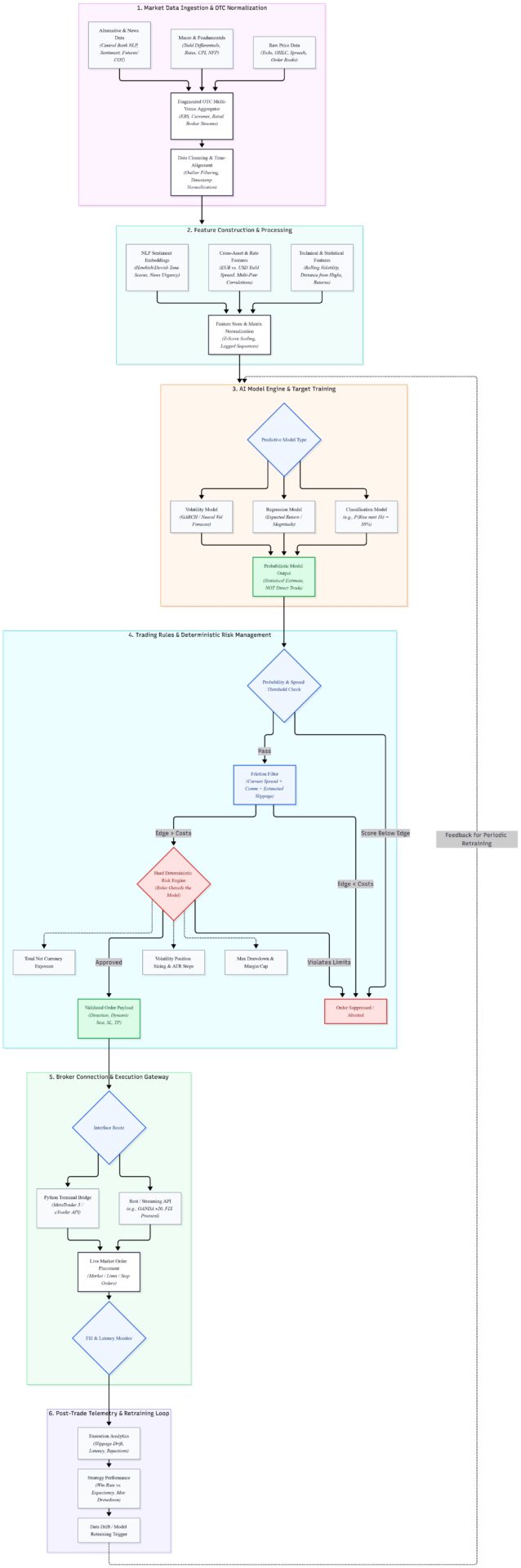
How AI Forex Trading Works
An AI trading system can be divided into several stages, including data collection, feature construction, model training, signal generation, position sizing, execution, and monitoring. If any one of these steps are poorly designed, it can be destructive for the end result.
Market Data
A model needs observations from which it can learn. Basic systems typically use historical open, high, low, and close prices. More advanced models can include things such as tick data, spreads, realised volatility, interest rate differentials, economic releases, options data, futures positioning, correlated assets, and news.
Foreign exchange presents a data problem that equity traders sometimes underestimate. Spot FX is primarily an over-the-counter (OTC) market rather than one built on central exchanges. There is no single consolidated order book containing every EUR/USD transaction. Prices and liquidity can differ between dealers, venues, and liquidity pools.
The BIS describes modern FX as a fragmented trading structure in which price discovery occurs across several parts of the market. This means an AI model trained on one retail broker’s historical prices may not see the same spreads, ticks, or execution conditions when deployed elsewhere.
Data quality is therefore part of the strategy. A beautiful neural network trained on questionable data will not perform well.
Data Sources
The model rarely receives a chart in the form a human sees it. Price information is received as numerical features, and a system might for instance calculate recent returns, moving averages, volatility, rate differentials, distance from a rolling high, correlations between currencies, and changes in spread conditions. Some models work directly with sequences of prices and attempt to identify useful representations automatically. Macroeconomic data can also be introduced. Currency prices respond to macroeconomic factors such as interest rates, inflation expectations, economic growth, and relative monetary policy. A model might for instance compare USD and EUR area yields when analysing EUR/USD rather than examining the exchange rate alone, just like a human trader can add fundamental analysis instead of relying on only on technical analysis. News creates another data source. Natural language models can classify central bank communications as more hawkish or dovish, identify references to inflation risks, or convert news headlines into sentiment scores. A language model can help with the job, but it is not a magic crystal ball that foretells the future.
The Model Learns a Relationship
Once inputs are prepared, the algorithm is trained against a defined target. The target could for instance be whether EUR/USD is higher one hour later, or the next day’s return, or future volatility, or the probability that a stop loss is reached before a profit target.
Different questions require different models. A classification model may estimate that EUR/USD has a 58% probability of rising during the next four hours. A regression model might estimate the expected return. Another model could predict volatility and leave direction entirely to a conventional trading strategy.
The important word is estimate. A model output of 0.58 does not mean the trade will work. It says that, according to relationships learned from its training data, observations with these characteristics historically produced one result more often than another. Even a genuine 58% probability can produce long runs of losing trades.
The Prediction Has to Become a Trading Rule
A prediction is not yet a strategy.
Suppose a model predicts that GBP/USD has a 54% probability of rising over the next hour.
Should the system buy?
That depends on factors such as the expected size of winning and losing moves, spread, commission, slippage, and model confidence.
A strategy with a 54% directional accuracy can still lose if average losses are larger than average gains. A strategy that correctly predicts 45% of moves can make money if winning trades are sufficiently larger.
Accuracy is not profit. The trading system has to translate forecasts into entry thresholds, position sizes, stops, profit exits, and maximum exposure.
Risk management normally belongs outside the predictive model. A trader may allow the AI system to score opportunities while fixed software controls maximum position size, account drawdown, and total currency exposure. That separation is useful because models occasionally behave strangely.
Connecting the Model to the Broker
An automated AI system needs a route to the market. This can be handled inside a trading terminal or through a broker application programming interface.
OANDA’s v20 API, as one example, provides programmatic access to market prices as well as functions for creating, modifying, and closing orders. Its developer documentation explicitly supports automated trading through the API.
For the well-known MetaTrader and cTrader platforms, another route is possible. The model can generate a signal externally in the programming language Python and pass an instruction to the trading terminal, or some of the model logic can run within the trading environment itself. Python has become one of the most popular languages for machine learning, data analysis, automation, and AI-assisted financial trading.
Execution details become important at this point. A backtest might assume a EUR/USD trade was filled at 1.15000. The live account gets 1.15004. It sounds irrelevant until a high frequency strategy makes thousands of trades. Spread changes, latency, rejected orders, and slippage can turn a small theoretical advantage into no advantage at all.
Machine Learning Models Used in Forex Trading
There is no single “forex AI algorithm”. Different models solve different problems.
Traditional statistical and machine learning methods
Traditional statistical and machine learning methods such as linear regression, logistic regression, decision trees, random forests, and gradient boosting remain useful because they are comparatively easy to test and inspect.
- Linear regression
Estimates a continuous value, such as the expected price change or return of a currency pair based on variables such as interest-rate differentials, volatility, momentum, or technical indicators. - Logistic regression
Estimates the probability of a particular outcome, such as whether EUR/USD will rise or fall over the next trading period. - Decision trees
Make trading decisions through a sequence of rules. For example: If momentum is positive AND volatility is below a certain level, consider a long position. - Random forests
Combine many decision trees to produce a more robust prediction. They can capture non-linear relationships between market variables without being as difficult to interpret as many deep-learning systems. - Gradient boosting
Builds a series of models sequentially, with each new model attempting to correct errors made by the previous ones. Methods such as XGBoost and LightGBM are commonly used for structured/tabular financial data.
More complex neural networks
More complicated neural networks can process sequences of market observations and capture relationships that simpler models may miss. Recurrent neural networks and related architectures have been used for financial time series. More recent systems may combine neural networks with attention-based architectures to analyze large amounts of market data and identify relationships that may be difficult to capture with simpler statistical models.
For a retail forex trader, the basic idea is easier to understand with an example. Suppose an AI system is trying to estimate whether EUR/USD is more likely to rise or fall over the next hour. It could examine recent price movements, volatility, trading activity, interest-rate differences, economic data, and movements in other currency pairs. A traditional model might give these inputs relatively fixed importance. An attention-based model can instead learn that different pieces of information may matter more under different market conditions. For example, recent price momentum might be particularly relevant during a strong trend, while an interest-rate announcement or sudden volatility spike could become more important around a major economic event.
This is where the term “attention” comes from. The model learns to place greater weight on information that appears more relevant to the prediction it is making. In sequence-based models, this can include relationships between different points in a historical price series rather than simply looking at the most recent observation.
Many modern attention-based systems are built using architectures known as transformers. These models have become important in AI because they can process relationships within sequences efficiently and can handle large and complex datasets.
But complexity is not automatically an advantage. Financial data contains large amounts of noise, changing relationships, and relatively few genuinely independent market regimes. A huge model can therefore learn the historical sample extremely well without learning anything that remains profitable. This is known as overfitting. An AI trading model can appear extremely successful when tested on historical data because it has learned the historical data, including random noise, rather than a pattern that continues into the future. A retail trader should therefore view attention-based AI as an advanced analytical tool, not as a prediction machine. The important questions remain whether the strategy works on unseen data, survives realistic spreads and trading costs, remains stable across different market conditions, and manages risk appropriately.
Reinforcement learning
Reinforcement learning is another approach often marketed for trading. Instead of learning a direct forecast, the system learns actions through a reward function. In theory, the agent can learn when to buy, sell, or remain flat. The problem is that the simulated environment has to resemble live markets closely enough for the learned behaviour to remain useful. A reinforcement learning agent can become exceptionally good at exploiting flaws in its simulator. The live forex market is under no obligation to preserve those flaws.
Large Language Models
Large language models occupy yet another category. They are particularly useful for text. Central bank speeches, economic commentary and news reports are natural inputs. They can also assist traders with research and code generation. Their weakness is treating factual sounding output as verified market data. For trading, an LLM is therefore more credible as part of an information processing pipeline than as an oracle producing naked buy and sell commands.
AI Forex Trading Software
There is no requirement to buy specialist “AI forex software” to build an AI trading system. Many credible setups use ordinary algorithmic trading software combined with Python machine learning libraries.
The following platforms illustrate various components that can be included in a setup.
| Software / Platform | Main Role | AI or Automation Capability | Notes |
|---|---|---|---|
| MetaTrader 5 | Retail trading and automation | Expert Advisors, MQL5, Python integration | EAs can be used without AI. |
| cTrader Algo | Automated strategy development | C# and Python cBots, testing and optimisation | Profitability still depends on strategy logic. |
| TradingView | Research, charting and signal prototyping | Pine Script strategies and server alerts | Primarily a strategy and alert environment rather than a general ML research stack. |
| Python | Data science and model development | scikit-learn, PyTorch, TensorFlow and data libraries | Requires programming, data handling and execution infrastructure. |
| QuantConnect | Quantitative research and deployment | Machine learning libraries and algorithm framework | More technical than plug-and-play retail robots. Particularly popular for combining Python, quantitative finance, and machine learning. |
| Broker APIs | Live market access and execution | Connect custom models directly to trading accounts | Broker availability, execution and API rules vary. |
MetaTrader 5 and Expert Advisors
MetaTrader 4 (MT4) and MetaTrader 5 (MT5) remains one of the most familiar automation environments in retail forex. On these platforms, the automated trading programs are called Expert Advisors (EAs). EAs can analyse prices and automatically execute trading operations according to programmed algorithms.
Most EAs are rules based rather than AI based. If you want to combine an EA with AI, you can train a model in Python, generate signals, and use MetaTrader as the execution layer.
MT5’s official Python package can retrieve market and account information for statistical analysis and machine learning workflows.
MT4 and MT5 are widely used and established trading platforms, but it is important to remember that the the presence of the MetaTrader brand in an AI trading product, strategy, or marketing pitch is never evidence that the product itself is legitimate, reliable, or profitable. MT4 and MT5 are simply platforms that can be used to execute and manage trades. They do not independently validate the quality of an AI model, the underlying trading strategy, the performance claims, or the credibility of the company offering the product. Traders need to evaluate the AI system themselves, instead of assuming that integration with a familiar platform is an endorsement. Important factors include independently verifiable performance, transparent methodology, realistic risk disclosures, audited or credible track records, fees, drawdowns, and the identity and regulatory status of the provider. In short, MT4 and MT5 are legitimate and useful trading platforms, but their presence does not automatically make an AI forex product trustworthy or its strategy profitable.
The CFTC specifically warns that fraudsters commonly use popular trading software to create the appearance of legitimacy. A genuine MetaTrader interface can sit in front of a dishonest operator. Trading platform brand, broker regulation, and AI validity are all separate questions.
cTrader Algo
cTrader is another well-known and popular trading platform. Just as with MT4 and MT5, a very large number of brokers offer cTrader integration.
cTrader has built automation directly into its Algo (algorithmic trading) environment. Its cBots can analyse market conditions, execute orders, and manage risk according to programmed instructions. cTrader supports development in both C# and Python, with historical backtesting and parameter optimisation available within the platform. Python support makes the environment more convenient for machine learning because much of the established data science stack already lives there.
Again, a cBot does not become AI simply because somebody puts AI in its product name. A fixed grid robot written in Python is still a grid robot.
TradingView and Pine Script
TradingView is a financial charting and market-analysis platform. If you connect a brokerage account you can also place trades from TradingView, but many traders use it only for financial charting and market-analysis, and place their trades on another platform.
Among other things, TradingView is useful for developing and testing systematic trading logic, especially when the strategy begins with technical conditions.
Pine Script strategies can simulate trades against historical and real time chart data and produce strategy reports. TradingView also allows strategies and indicators to generate server based alerts.
TradingView is less suitable as the sole environment for heavy machine learning research. A common arrangement is therefore to use TradingView for signal logic or alerts and connect those alerts to external execution infrastructure. This is automation, but not necessarily artificial intelligence.
Python and Quant Research Frameworks
An AI forex developer that wants a high degree of flexibility can collect historical data, engineer features, train a model with scikit learn or a neural network framework, test forecasts, and send decisions to a broker API. (Scikit-learn is an open-source Python library for classical machine learning and data mining. It is one of the most widely used tools in the Python data science ecosystem because of its consistent API, extensive documentation, and broad collection of algorithms for supervised and unsupervised learning.)
The advantage of this approach is control. The disadvantage is also control. The developer is responsible for data cleaning, time alignment, model validation, transaction cost assumptions, order handling, error recovery, and live monitoring.
QuantConnect provides a more structured environment for quantitative research and algorithm deployment. Its documentation includes machine learning examples using libraries such as scikit learn, TensorFlow (Google’s open-source machine-learning framework) and PyTorch (an open-source deep-learning framework with a strong focus on flexibility and research), while its framework separates signal generation, portfolio construction, execution and risk management. That separation is a useful architectural principle for AI trading more broadly. Prediction should not be confused with portfolio construction, and portfolio construction should not be confused with execution.
Backtesting an AI Forex Strategy
Backtesting is necessary and also extremely easy to get wrong. The largest danger is allowing the model to see information that would not have been available when the trade was made. This is data leakage. Suppose a trader normalises ten years of EUR/USD data using the mean and standard deviation calculated over the entire ten years, then claims to test the first five years independently. Information from the future has already entered the calculation. The scikit learn documentation explicitly warns that data leakage produces overly optimistic estimates and that preprocessing parameters must be learned only from training data.
Ordinary random cross validation can also be inappropriate for financial time series. Tomorrow should not be used to predict yesterday. For time ordered data, scikit learn recommends methods such as TimeSeriesSplit, where later observations are reserved for testing and earlier observations form the training set. TimeSeriesSplit is a cross-validation method in scikit-learn designed for time-ordered data such as forex, stocks, and other financial time series. The key idea is to train on the past, test on the future. You don’t randomly shuffle observations as you might with ordinary cross-validation.
A useful AI forex test should also include realistic spreads, commissions, financing, and slippage. This matters even more for high turnover systems. A model that earns two basis points per trade before costs and pays three basis points to trade will not make a profit.
Out of sample testing should then be followed by forward testing on unseen live data, ideally using a high-quality practice environment before real capital is exposed.
When AI Forex Models Fail or Create New Risks
Currency relationships are unstable because the economic environment changes. A strategy trained during years of near zero interest rates may behave differently once central banks raise rates sharply. A model trained during ordinary volatility can react badly during an intervention, surprise election, war, or sudden liquidity shock. And so on. This is usually described as regime change or model drift.
In addition to this, markets are adversarial. If a straightforward predictive relationship becomes known and profitable, other traders attempt to exploit it. Their trading can reduce or remove the original opportunity. AI does not get to compete against a static spreadsheet. It competes against other participants, including large banks, market makers, hedge funds, algorithmic traders, and traders using their own AI systems.
The Bank of England has also warned about broader market risks if many institutions use similar AI models. Correlated models can generate correlated positions, and leveraged strategies may amplify price movements under stress. On 31 October 2024, Sarah Breeden, Deputy Governor for Financial Stability at the Bank of England, delivered a keynote speech at the Hong Kong Monetary Authority on the implications of artificial intelligence for financial stability. Her speech, titled “Engaging with the machine: AI and financial stability,” focused not on whether AI should be used in finance, but on how regulators can allow its benefits while managing the risks that could emerge as adoption increases.
Breeden identified several characteristics that make modern AI models particularly important from a financial-stability perspective. AI systems can be dynamic, meaning their behaviour can change as they learn from new data. They can be difficult to explain. They may depend on very large and potentially problematic datasets. And financial firms may increasingly rely on a relatively small number of common AI models and infrastructure providers. She also highlighted the growing autonomy of AI systems, raising questions about whether managers can adequately understand and remain accountable for decisions made by increasingly automated systems.
For traders, one of the most important concerns is correlated trading behaviour. If many banks, funds, or other market participants use the same or similar AI models, those systems could potentially respond to market information in similar ways. This could create crowded positions. Under normal conditions, this may not present a major problem. But during a market shock, simultaneous attempts to reduce risk or exit similar positions could accelerate price movements. If those positions are leveraged, losses and forced selling could create feedback loops that amplify market stress.
Breeden also noted a related risk: sophisticated AI trading systems could potentially learn to exploit the behaviour of other algorithms. A strategy that is individually rational and profitable could nevertheless contribute to instability when many automated systems interact. Importantly, Breeden did not argue that AI trading was inherently unsafe or that new regulation was immediately required. Instead, she stressed the need for continued monitoring, stronger model-risk management, appropriate governance, and stress testing capable of examining how AI systems might interact across the financial system.
AI Forex Trading Scams and Inflated Promises
Old scams with new labels
The AI hype has given forex fraudsters a new vocabulary.
In many cases, the underlying pitch and mechanics of their cons have barely changed, the fraudsters have just added the AI label to the sales pitch. Twenty years ago, somebody sold a “secret institutional forex system”. Later, the pitch was for an amazingly superior Expert Advisor for MT4 and MT5. Then, it became a neural network trading robot. Now, it is an autonomous AI trading engine trained on billions of market data points. The descriptions change more often than the underlying fraud.
The CFTC issued a dedicated warning in January 2024 after seeing investment schemes promote AI trading bots, signal algorithms, and arbitrage systems with claims of unusually high or guaranteed returns. It specifically warned about claims of 100% win rates and enormous percentage gains.
One case cited by the regulator is particularly instructive.
“Case Study: Mirror Trading International
Over about a three-year period, Cornelius Johannes Steynberg, a citizen of the Republic of South Africa, stole more than $1.7 billion in bitcoin from at least 23,000 people using a few websites, as well as accounts on Facebook, Instagram, and YouTube.
For as little as $100 in bitcoin, and with “no trading experience required,” customers could buy into his commodity pool that used a proprietary bot trading program that guaranteed at least a 10 percent monthly return (or more than 200 percent per year) trading foreign currencies. Customers could refer friends or work as affiliate marketers and receive referral bonuses. Steynberg also created fake customer accounts and balances using MetaTrader demo accounts.
In reality, very little money was actually traded. Instead, it operated as a Ponzi scheme with some money from new investors used to pay older investors and the rest misappropriated by Steynberg. [See CFTC Press Releases 8549-22 and 8696-23].” Source: CFTC Customer Advisory Cautions the Public to Beware of Artificial Intelligence Scams
The Mirror Trading International scam promoted a purported proprietary trading bot that supposedly generated at least 10% monthly returns through forex trading. The CFTC says the operation took more than $1.7 billion worth of bitcoin from at least 23,000 people. Very little actual trading occurred and fake MetaTrader demo accounts were used to display fictitious customer balances.
FINRA reported another pattern in 2025. It warned of increasing numbers of unregistered automatic trading services promoting beginner friendly or supposedly low risk systems, with some claiming consistent monthly returns above 10% and invoking AI as justification.
AI tools are also very convenient for fraudsters who want to make their scam more believable. An AI generated video can even put a claim or endorsement in the mouth of someone who never said it. The CFTC warned in March 2025 that generative AI is making it easier to produce fake financial websites, social media accounts, identities, documents, voices, and videos.
Examples of actions against AI scammers
Delphia (USA) Inc. and Global Predictions Inc.
Regulators are not just warning traders, they are also taking action against firms making false or misleading statements about their use of AI. In March 2024, the U.S. Securities and Exchange Commission (SEC) announced settled charges against investment advisers Delphia (USA) Inc. and Global Predictions Inc. for making false and misleading statements about their purported use of AI in their investment processes.
The SEC found, among other things, that Delphia made claims about AI and machine-learning capabilities that it did not actually possess, while Global Predictions made misleading claims about its purported AI-driven financial advisory platform.
Both firms settled the SEC’s charges without admitting or denying the findings, agreed to cease and desist from future violations, and were censured. Delphia agreed to pay a $225,000 civil penalty, while Global Predictions agreed to pay $175,000, for a combined $400,000. The settlements were announced on March 18, 2024.
Rimar Capital USA Inc.
On October 10, 2024, the SEC announced settled charges against Rimar Capital USA, Inc., Rimar Capital, LLC, Itai Royi Liptz, and Clifford Todd Boro concerning fraudulent and misleading representations about Rimar LLC’s purported AI-powered automated trading platform.
According to the SEC’s findings, the respondents raised nearly $4 million from 45 investors while making misrepresentations about the platform’s capabilities, assets under management, investment performance, and purported use of AI. The SEC also found that Liptz improperly used some company funds for personal expenses.
The respondents settled the administrative and cease-and-desist proceedings without admitting or denying the SEC’s findings. Liptz was ordered to pay $213,611.25 in disgorgement and pre-judgment interest and a $250,000 civil penalty, and was subject to an investment-company prohibition and an associational bar with the right to reapply after five years. Boro was ordered to pay a $60,000 civil penalty, while Rimar LLC was censured. The SEC stated that the respondents were ordered to pay $310,000 in civil penalties collectively, and it established a Fair Fund so that penalties collected could be distributed to harmed investors.
For more information, see https://www.sec.gov/files/litigation/admin/2024/33-11316.pdf.
Singapore Index Trading Institute Pte. Ltd. (SITI)
So far, a majority of the high-profile cases have played out in the United States, but other regulators are also being active. In 2025, Ong Kai Min was convicted in Singapore after promoting an investment scheme through that purported to use AI programs to conduct automated trades, including leveraged foreign-exchange trading. Investors were promised substantial monthly returns, but investigators found that no genuine trading was conducted with their funds. Ong Kai Min pleaded guilty to eight amalgamated counts of cheating and was sentenced to 93 months’ imprisonment on 19 September 2025.
Ong Kai Min was the director of Singapore Index Trading Institute Pte. Ltd. (SITI), which promoted investment schemes claiming that AI programs would conduct automated trades in financial instruments, including leveraged foreign exchange and indices, on behalf of investors. Investors were told that the AI programs had historical returns of at least 3% per month and projected returns of 2%–10% per month. Investors were directed to deposit funds with SITI or another company controlled by Ong Kai Min, while the trading accounts and apparent profitable trades shown through MetaTrader 4 did not reflect genuine trading activity.
The scheme raised more than US$537,000 and S$3.9 million from investors. Ong Kai Min was charged in Singapore in January 2025 with 23 counts of cheating and one count of intentionally obstructing the course of justice. On 27 August 2025, Ong pleaded guilty and was convicted on eight amalgamated counts of cheating. Sixteen additional charges were taken into consideration for sentencing. On 19 September 2025, he was sentenced to 93 months (7 years and 9 months) in prison.
Sources:
https://www.police.gov.sg/-/media/SPF/Media-Room/Publications/CAD-Report-2024/CAD-Report-2024.pdf
The lesson is not that every AI-based strategy is fraudulent. It is that fraudsters are very fond of using AI claims in their pitches right now, and that the “evidence” shown to traders proves remarkably little. A simulated account can be manipulated. A screenshot can be edited. An equity curve can be generated from selected historical periods. And so on. No AI model removes market risk. Promises of fixed daily returns, guaranteed monthly income, near perfect win rates or “zero drawdown” deserve our severe scepticism.
How to Assess an AI Forex Trading Product
A credible system should be able to explain what the AI actually does. “Military grade neural network” is not an explanation. The provider should be able to describe its inputs, general model type, trading horizon, risk controls, and circumstances in which the strategy is expected to perform poorly. All this can be done without revealing proprietary code, so don´t buy that common excuse.
Performance evidence also needs context. A backtest should identify its data period, transaction cost assumptions and whether results are genuinely out of sample. Live results are stronger than simulations, but account statements need to be independently verifiable.
Maximum drawdown often says more than win rate. A grid or martingale system can produce a period of attractive wins by repeatedly increasing exposure after losses. Its win rate looks superb until one market move wipes out several months of profits.
Key Realities of AI Forex Trading
- Distinction Automation ≠ Intelligence Traditional MT4/MT5 EAs execute fixed rules. Genuine AI dynamically infers probabilities from multi-variable data.
- Data Reality Fragmented OTC Liquidity Spot FX has no single consolidated order book; spreads and order books vary by dealer and venue.
- Critical Pitfall Data Leakage & Overfitting Normalizing across future data produces stellar backtests that instantly fail in forward live markets.
- Regulatory Red Flag Zero-Drawdown Claims The CFTC, SEC, and FINRA explicitly warn that no algorithmic system can eliminate market risk or promise static returns.
You need to assess the broker too
Some AI systems are tied to you using a specific broker. Do not sign up with any broker that isn´t licensed and supervised by a reputable financial authority, preferably the one relevant for your own jurisdiction.
In the United States, the CFTC recommends checking forex firms and individuals through registration records and the NFA BASIC database. In the United Kingdom, investors can verify permissions using the FCA’s official Firm Checker and Financial Services Register rather than relying on a licence number copied onto a website.
The same principle applies elsewhere in the world. Know the exact legal entity in the User Agreement and verify it directly with the regulator. Do not rely on badges on a website and do not follow links provided by the broker. Find the applicable regulator on your own and verify any broker claims directly with them.
When AI software sellers want to hold or control customer funds
This is a particularly sensitive regulatory issue because providing AI-powered software and providing custody or investment-management services are distinct activities. A company may legitimately develop and sell analytical, trading, or decision-support software without itself taking custody of customer assets.
The regulatory considerations change substantially when a company asks customers to transfer money or digital assets to a wallet or account controlled by the company, deposit funds into an account purportedly managed by the company’s AI system, or otherwise gives the company control over customer assets.
Depending on the structure, the activities may implicate requirements relating to custody, investment advisory services, broker-dealer activities, money transmission, or other regulated financial services.
A company claiming that it is merely providing AI software is not, by itself, enough to determine whether its activities are subject to financial regulation. The relevant analysis depends on what the company actually does with customer funds, who controls the assets, how transactions are executed, and the legal and regulatory framework applicable to the particular business and jurisdiction.
What AI Can Realistically Add to Forex Trading Right Now
AI does have legitimate uses in foreign exchange. It can for instance process more variables than a discretionary trader can reasonably monitor. It can detect statistical relationships, classify market conditions, analyse text, automate repetitive decisions, and react consistently without fatigue.
It can also make bad decisions.
That is why the strongest use case is not replacing every trading function with one model. It is using specialised models inside a controlled trading process.
An AI system can estimate volatility while deterministic software controls leverage. Another model can rank trade opportunities while a separate execution engine controls orders. Natural language processing can score central bank communication while the trader decides whether the signal is economically meaningful.
Even institutions use AI this way. A 2025 Bank for International Settlements (BIS) research project, as one example, used a recurrent neural network to forecast signs of stress in FX markets from more than one hundred market indicators. It then used a language model to add news context to variables highlighted by the forecasting model. This was a structured two stage system rather than a chatbot asked to guess the yen.
Machine learning can be a tool for research, classification, execution, and risk analysis. Automated platforms can make systematic strategies easier to deploy. Broker APIs allow models to interact directly with live markets. None of those capabilities creates guaranteed alpha.
The hardest parts of trading remain exactly where they were before the AI label arrived. You need to find a relationship that persists outside the historical sample, trading it after costs, controlling risk when the relationship fails, and resisting the temptation to mistake a convincing backtest for a law of finance.
AI may change the technology used in financial markets, but it does not eliminate market risk.
Frequently Asked Questions
Can AI predict forex prices with 100% accuracy?
No. Foreign exchange markets are non-stationary, decentralized, and heavily influenced by unexpected macroeconomic and geopolitical events. Even advanced machine learning models output probabilities rather than certainty, and no model can guarantee risk-free returns.
Are MetaTrader 4 and MetaTrader 5 Expert Advisors (EAs) considered AI?
Most Expert Advisors are deterministic rule-based algorithms (such as moving average crossovers or grid systems), not artificial intelligence. However, traders can integrate machine learning models built in Python with MT5 via its official API to supply real-time predictive signals to an EA.
Is AI forex trading legal?
Yes, algorithmic and AI-assisted trading is legal across major regulated jurisdictions including the US (CFTC/NFA), UK (FCA), Europe (ESMA), and Australia (ASIC). However, selling automated trading programs while holding customer funds or promising guaranteed returns often violates securities and financial advisory laws.