Slippage, Requotes, and Last Look in Forex
Slippage, requotes, and last look all describe events that occur between a trader submitting an order and receiving the final execution result.
- Slippage is the difference between the price a trader expected and the price received. Slippage produces a completed trade at a price different from the expected price. The trader receives a fill, although the result may be better or worse.
- A requote is a new price offered because the original requested price is no longer available. A requote does not complete the trade. The original price is declined and another price is presented for approval. The trader decides whether to proceed or not.
- Last look is an execution practice in which a liquidity provider has a brief period after receiving a trade request to accept or reject the transaction against its quoted price. The trade request is sent to the liquidity provider after a quote has been displayed, and the provider may perform checks such as price validation, credit controls, risk management, or technical validity checks before confirming execution. If the request is rejected, the trade is not executed at the quoted price. Depending on the trading system, the rejection may result in a new quote, a new order request, or no transaction taking place.
These execution effects matter because spreads do not show the complete cost of trading. A currency pair may display a narrow bid and ask spread, yet an order can still be filled at a worse price, delayed, or rejected. Conversely, a trader may receive positive slippage and enter or exit at a better price than expected. The ultimate result depends on a variety of factors, including market liquidity, order type, trade size, network latency, and the execution model being used. Traders who look only at advertised spreads may miss a material part of their actual trading costs.
The same order can involve more than one of these events. A retail platform may send an order to a liquidity provider using last look. If the request is rejected, the platform may return a requote. If the trader accepts the new price and the order is filled slightly away from it, slippage has also occurred.
Slippage, requotes, and last look are normal parts of electronic foreign exchange execution, and each affects traders. Slippage changes the final trade price. Requotes require the trader to consider a replacement price. Last look allows a liquidity provider to accept or reject a request after checking validity and current pricing. None of these practices is automatically unfair. Problems arise when execution is asymmetric, disclosures are vague, or these concepts are used as a plausible cover for deliberate manipulation.
Traders should evaluate the complete execution record rather than relying on advertised spreads. Fill prices, rejection rates, and response times reveal more about trading costs than a promotional minimum spread ever will.
How Forex Order Execution Works
The foreign exchange (Forex or FX) market is primarily an over-the-counter (OTC) market. Rather than operating through centralized exchanges, transactions occur electronically across a global network of market participants, including banks, non-bank liquidity providers, electronic trading venues, prime brokers, proprietary trading firms, and retail trading platforms.
A price displayed on a retail trading platform represents the bid or ask currently available through that broker’s pricing system. It does not mean an unlimited quantity can be traded at that level, nor does it guarantee that the quote will remain available while an order travels from the trader’s device to the execution system.
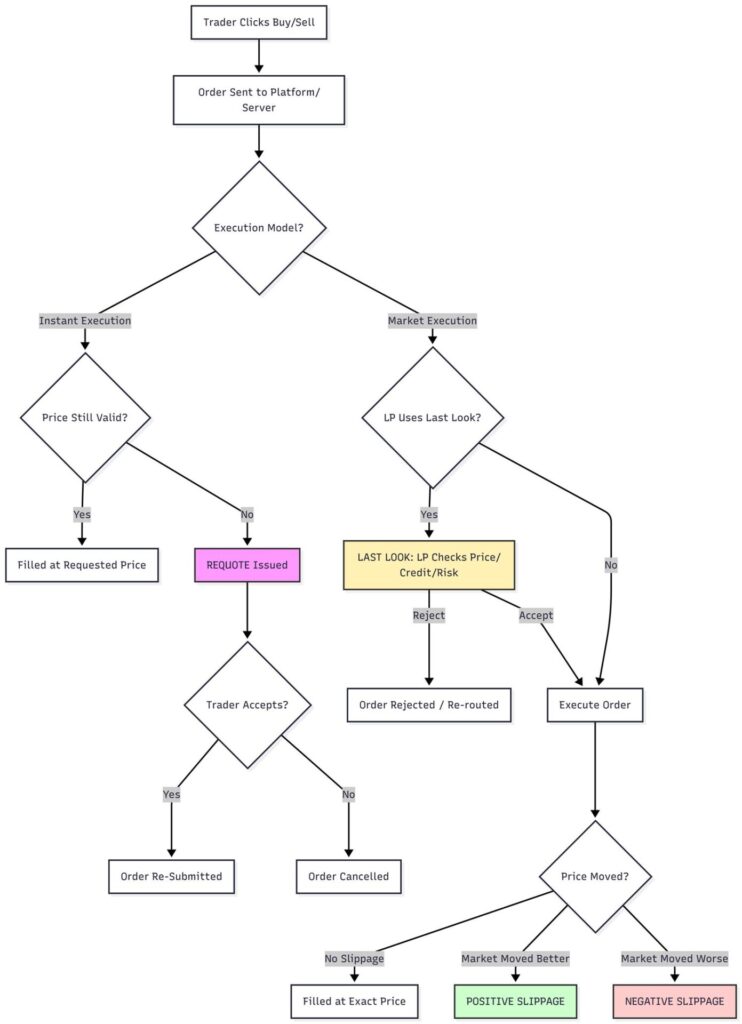
A basic market order passes through several stages. The trader clicks buy or sell, the platform records the request, the order travels through the relevant servers, and the execution system checks whether a suitable price is available. The order is then filled, rejected, or returned with another price offer (requote), depending on prevailing conditions, the execution method, and account terms.
Even a process completed in a fraction of a second leaves time for the forex market to move. Currency prices can update several times before an order reaches its final destination, especially during economic announcements or periods of low liquidity.
Market Orders, Limit Orders, And Stop Orders
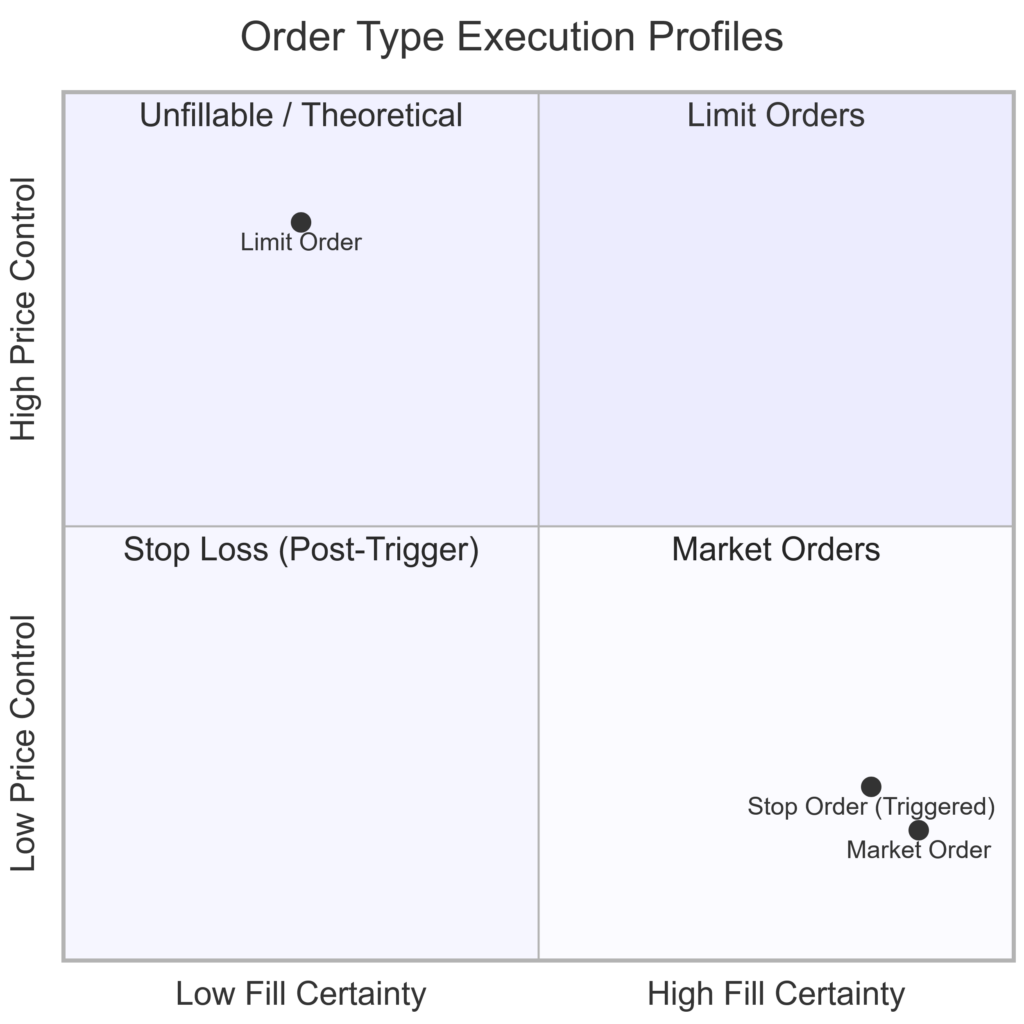
A market order prioritises execution rather than price certainty. It asks for a trade at the best available price when the order reaches the execution system. The displayed quote is a reference point, not a guaranteed fill price.
A limit order sets a maximum purchase price or minimum sale price. A buy limit should not be executed above its limit, while a sell limit should not be executed below it. The trade may receive a better price, but it may also remain unfilled if the required price is unavailable.
A stop order, also known as a stop-loss order, behaves differently. When the asset price reaches the stop level, this triggers the order. On many platforms, a triggered stop orders becomes a market order. This means execution is prioritised over price certainty. Essentially, the trader wants the position closed at the best available price. When markets are volatile and the asset price jumps through the stop level, the fill can occur several pips away. A stop loss controls when an exit is requested, but will not guarantee the execution price.
It is important to remember that order definitions and triggering rules can differ between platforms. Traders should for instance check whether stop orders are triggered by bid prices, ask prices, mid prices, or some other reference. Small differences matter when spreads widen sharply.
Slippage
What Is Slippage?
Slippage is the difference between the requested or expected trade price and the actual execution price.
Suppose EUR/USD displays an ask price of 1.08500 and a trader submits a market order to buy. If the order is filled at 1.08504, the trader has experienced four tenths of a pip of negative slippage. If the order is filled at 1.08497, the trader has received three tenths of a pip of positive slippage.
Slippage does not automatically indicate misconduct. It can arise because the market changed while the order was being transmitted and processed. It can also occur because there was not enough liquidity to complete the full order at the displayed price.
The relevant question is not whether slippage ever occurs. Some degree of price variation is normal in an active market. The better question is whether slippage is distributed fairly, whether favourable price changes are passed to clients, and whether the execution policy matches the platform’s published terms.
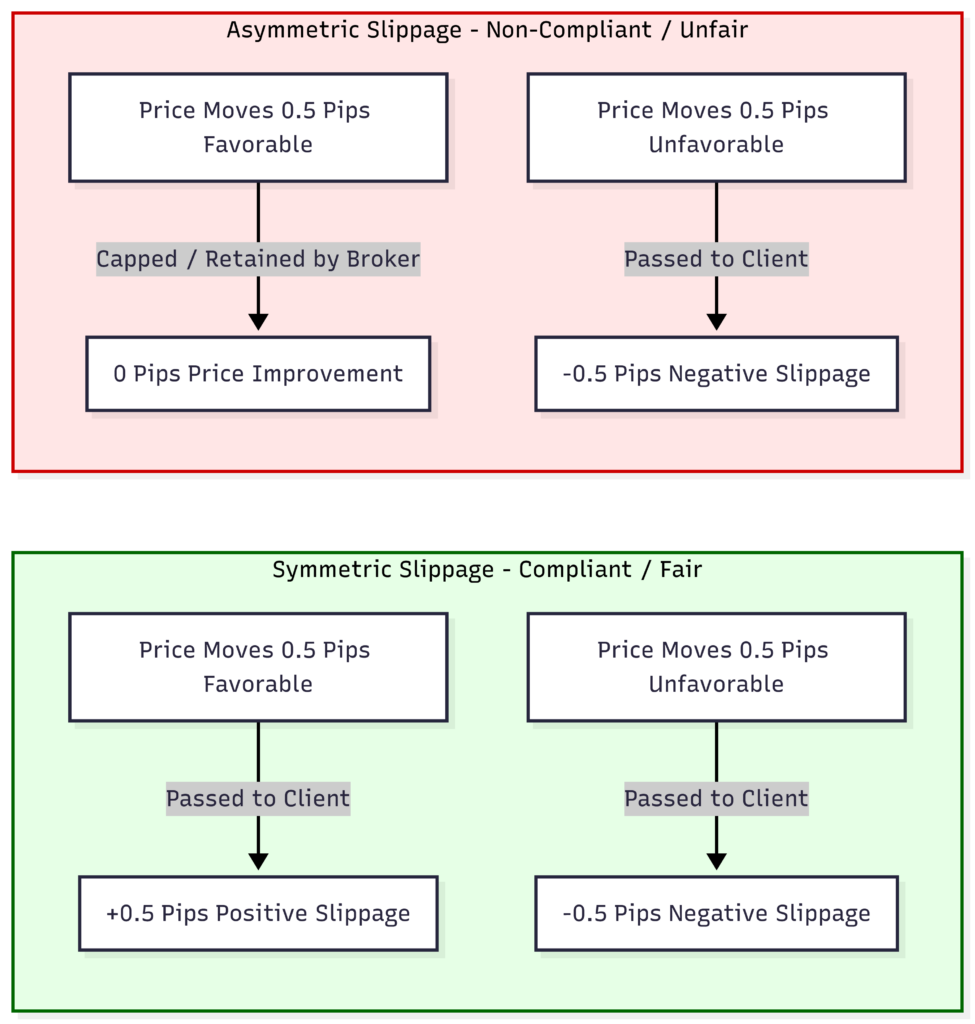
In the example above, the first scenario involved negative slippage, while the second scenario is an example of positive slippage. Negative slippage occurs when the execution price is worse than expected by the trader. For a buy order, this means paying a higher price. For a sell order, it means receiving a lower price. Positive slippage occurs when the fill is better. A buy order is completed below the expected price, or a sell order is completed above it. Both negative and positive slippage can occur under a neutral market execution process. Price movement does not always favour the dealer or liquidity provider. If, however, a system is employed where negative slippage is passed on to the trader while positive slippage is retained by another party (e.g. the broker), we have situation where slippage is asymmetric.
Asymmetric slippage has attracted regulatory attention because it changes what should be two-way price risk into a one-way cost for the customer. In the United States, the National Futures Association’s retail forex guidance states that slippage settings should be applied uniformly regardless of the direction in which the market has moved. A Forex Dealer Member (FDM) must apply the slippage settings uniformly regardless of the direction the market has moved.
“In the context of FDM trading systems, price slippage sometimes occurs between the time a customer first submits an order and the time the order reaches the FDM’s system. When this occurs, some FDMs immediately requote the customer the current price and require the customer to confirm that it still wants to place the order at the requoted price. Other FDMs have built in slippage parameters that permit execution of the order if the slippage is within the established parameters. FDMs that use slippage parameters must apply the slippage settings uniformly regardless of the direction the market has moved. If the FDM requotes prices when the market moves against it, it must requote prices when the market moves in its favor. In addition, FDMs must ensure that the customer is aware of how the FDM handles these price change circumstances prior to trading with the FDM by providing full written disclosure of its policy, including the information outlined in NFA’s Interpretive Notice entitled, NFA Compliance Rule 2-36: Requirements for Forex Transactions.”
Source: NFA – Forex Transactions: Regulatory Guide – Customer Orders – Price Slippage
In Europe, the Cyprus Securities and Exchange Commission (CySEC) has gone further than most other national regulators within the EU, and explicitly identifies asymmetric slippage as unacceptable for retail accounts. Following supervisory reviews of CFD and FX brokers, CySEC published a Q&A that includes answers regarding practises such as limiting positive slippage for the trader while passing through negative slippage to the trader, asymmetric limits on positive and negative slippage, and execution practices that benefit the firm at the expense of traders.
In their March 2017 “Questions and Answers Relating to the provision of CFDs and other speculative products to retail investors under MiFID”, CySEC provides examples of practices that are unacceptable given a firm´s best execution obligations and client order handling requirements under Article 22 of MiFID.
- One of the examples is when a firm limits the maximum positive price slippage possible in favour of the client (e.g. 0%, 25%, 75%) or assigns a maximum positive slippage per volume for market or pending orders, effectively disadvantaging the client vis-à-vis the firm.
- Another example is when a firm applies asymmetric limitations to the maximum positive and negative price slippage (in favour of the client and to client’s disadvantage), above which client orders will be rejected or re-quoted.
For more information, see CySEC, Q&A Relating to the provision of CFDs and other speculative products to retail investors under MiFID (ESMA35-36-794), Section 2, Q1, para. 36 (31 March 2017). Note: The original guidance referenced MiFID I Articles 21 and 22; equivalent obligations now exist under MiFID II Articles 27 and 28.
How Is Slippage Calculated?
For a buy order, slippage can be calculated by subtracting the requested price from the execution price.
- Buy slippage = execution price − requested price
For a sell order, the calculation is reversed.
- Sell slippage = requested price − execution price
A positive result under these formulas represents a cost to the trader. A negative result represents price improvement.
Example: Suppose a trader buys €100,000 against the US dollar (one standard EUR/USD lot) at an expected execution price of 1.09000 but is executed at 1.09008. The difference between the expected and actual execution price is 0.00008, which equals 0.8 pips (one pip in EUR/USD is 0.00010). For a standard EUR/USD lot, where the account currency is USD, one pip is worth exactly $10. Therefore, the unfavorable slippage cost is 0.8 pips × $10 per pip = $8. The trader has effectively paid $8 more than expected due to the execution price moving against them between the expected and actual fill prices.
That amount appears modest, but it grows with volume and frequency. A strategy completing 1,000 standard lot transactions with average adverse slippage of 0.3 pips would incur about $3,000 in added execution cost. This comes on top of the spread, commission, financing, and any market losses when we calculate the strategy´s overall profitability.
Why Slippage Happens
Fast price movement is the most obvious cause. Inflation reports, employment data, central bank decisions, and unexpected political news can cause quotes to update faster than orders can be processed.
Low liquidity has a similar effect. During quiet trading hours, public holidays, and the daily rollover period, fewer counterparties may be willing to trade at each price. Even a moderate order can consume the available quantity and move to the next price level.
Order size matters. The best displayed price may only be available for a portion of the requested amount. A large order can be filled across several levels, producing a volume weighted average price that is worse than the top quote.
Latency introduces another source of execution variation. Factors such as the physical distance between the trader and execution infrastructure, internet connection quality, device performance, network routing, and system processing times can increase the delay between observing a price and the order being received and executed. Under normal market conditions, a few additional milliseconds may have little impact, but during periods of rapid price movement or for short-term automated strategies, even small delays can contribute to differences between the displayed price and the final execution price.
The relationship between technical setup, latency, and slippage
Latency is the time delay between a price being observed and an order being received, processed, and executed. This delay can contribute to slippage because the market price may change during the interval between the trader’s decision and the final execution. The greater the delay, the greater the possibility that the available execution price will differ from the displayed price.

Some sources of latency are within the retail trader’s control. A a device with sufficient processing capacity, a stable router, a fast and reliable internet connection, can reduce delays on the trader’s side. An overloaded computer (e.g. because you are running unnecessary applications in the background), weak Wi-Fi signal, and unstable network conditions can slow the transmission of orders and increase the likelihood of execution at a different price.
Other sources of latency are outside the trader’s direct control. These include the broker’s trading infrastructure, server capacity, order-processing systems, liquidity provider connections, and the physical location of execution servers. The quality and speed of the broker’s connection to liquidity providers can affect how quickly orders are processed and whether prices remain available when execution is attempted. This is why broker selection is an important factor in execution quality. A trader cannot eliminate all latency because electronic markets involve multiple systems and participants, but choosing a broker with reliable technology, efficient order routing, appropriate server locations, and transparent execution practices can reduce avoidable sources of delay.
Latency does not automatically create unfair execution. In fast-moving markets, price changes can occur even with efficient systems. The key issue is whether delays arise from normal market conditions or from avoidable weaknesses in the trader’s or broker’s technical setup.
Of course, the quality of a trading setup is influenced by cost considerations. Reducing latency requires investment from both traders and brokers. For retail traders, reducing latency may involve expenses such as a more reliable internet connection, better hardware, or the use of a paid virtual private server (VPS) located closer to the broker’s servers. These improvements may or may not provide benefits that justify the costs, depending on the trading strategy and market conditions.
For brokers and liquidity providers, maintaining low-latency execution requires significant investment in technology, including server infrastructure, network connectivity, system optimisation, and access to liquidity venues. These costs may affect the services offered, pricing models, and execution arrangements available to clients. As a result, execution quality often reflects a balance between speed, reliability, cost, and the type of trading service being provided.
Requotes
What Is A Requote?
A requote occurs when the price requested by the trader is not accepted and a replacement price is offered.
The trader may then accept the new price, reject it, or allow the quote to expire. This differs from ordinary slippage, where the order is completed at another available price without asking the trader to approve the change.
Suppose GBP/USD is quoted at 1.27000 and the trader clicks buy. By the time the request is processed, the available ask has moved to 1.27010. Under a requote system, the platform can respond with the new price of 1.27010 instead of filling the order automatically.
A requote can protect the trader from being filled at an unwanted level, but it also introduces delay. If the trader accepts the new price after another short pause, the market may have moved again. A second requote can follow, which is particularly frustrating in fast markets.
Some retail forex systems issue a new quote when prices move, while others use preset slippage tolerances that allow an order to execute within an accepted range.
Market Execution vs. Instant Execution
Requotes are commonly associated with the instant execution model. Under this model, the trader requests a trade at the displayed price. The order is filled at that price if it remains acceptable. If not, the request is rejected and a new quote returned.
Market execution works differently. The trader submits an order for execution at the best available price. The order can be completed above or below the displayed quote, subject to any tolerance or protection settings. Requotes are less common because the trader has already accepted that the execution price may vary.
The names used by trading platforms are not always consistent. Two firms can both use the term “market execution” while applying different routing, rejection, and price tolerance rules. The contractual execution policy matters more than the label shown in the order window.
It should be noted that the absence of requotes does not necessarily mean that execution quality is better, even if it may appear more convenient for the trader. A trading system can eliminate requotes by accepting all orders while allowing unlimited negative slippage, which may result in worse execution outcomes for the customer. The presence of requotes does not, by itself, indicate unfair dealing, as requotes may occur when a price has moved beyond the defined execution parameters. The key consideration is whether the execution policy applies equivalent treatment to favourable and unfavourable price movements, and whether any slippage or price adjustment mechanisms operate consistently in both directions.
Last Look
What Is Last Look?
Last look gives a liquidity provider a final opportunity to accept or reject a trade request made against its quoted price. The price may have been visible on a platform, aggregator, or streaming feed, but the trade is not final at the instant the customer submits the request. The liquidity provider performs a short validity or price check before returning an acceptance or rejection.
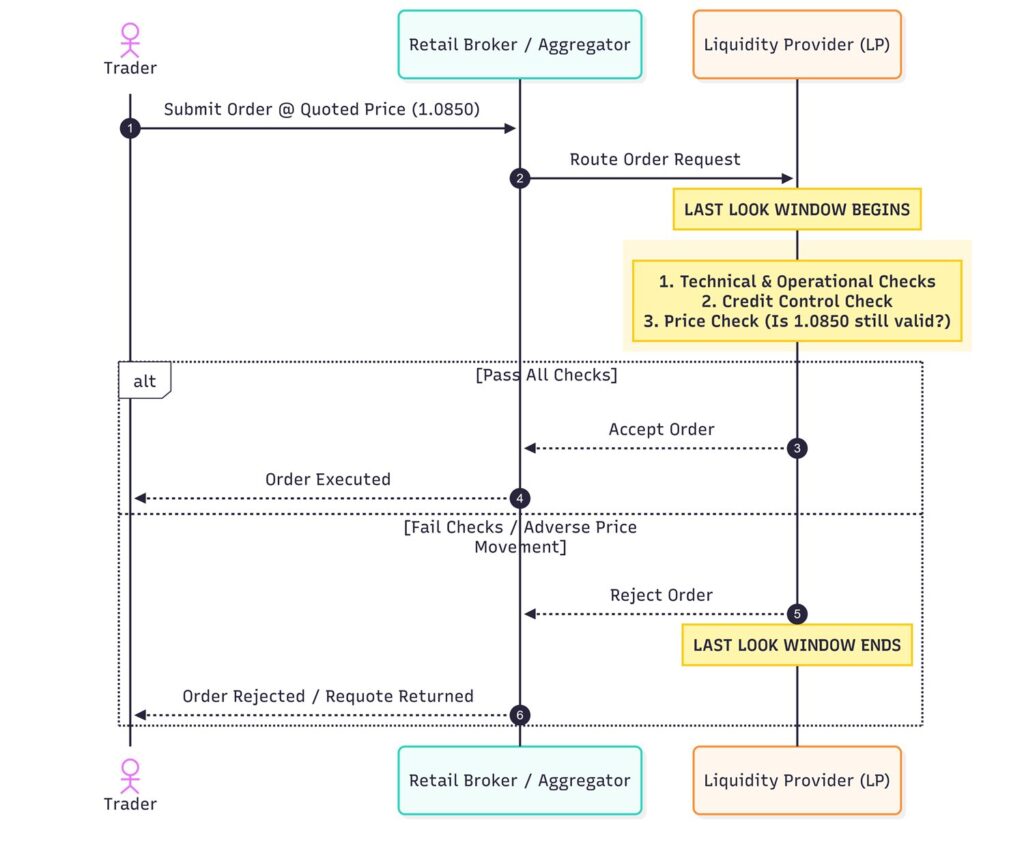
Last look is a common execution practice in institutional foreign exchange markets. It allows a liquidity provider a brief period after receiving a trade request to accept or reject execution against a previously displayed quote, typically for purposes such as price validation, technical checks, credit controls, and risk management. The trader is exposed during this window. If the request is rejected after the market has moved, the trader must submit another order at the new price. That creates market risk. The length of the last look window can therefore affect execution. A longer window gives the liquidity provider more time to check the request, but also gives market prices more time to move before the customer receives a decision.
Retail traders might not see the term last look displayed in the trading platform or have it explained in their user agreement. But last look can occur further up the execution chain, between a trading venue, aggregator, and underlying liquidity provider. A retail order may therefore be affected by a rejection even where the customer deals only with the platform shown on screen.
Even though the practise is common, last look is not uncontroversial. Because the liquidity provider observes the trade request before confirming execution, last look practices have attracted regulatory and industry scrutiny regarding potential conflicts of interest and the selective rejection of trades. Several major non-bank market makers, including Citadel Securities, Jump Trading, Virtu Financial, and XTX Markets, have publicly criticized traditional last look practices and advocated moving toward firm pricing. A recurring argument is that modern electronic markets should manage adverse selection through pricing and risk controls rather than by giving LPs a post-trade decision window.
The FX Global Code does not take a stance against last look. Instead, it states that market participants using last look should disclose that the practice is being used and provide sufficient information about its operation, including the expected last-look time period, the factors that may influence acceptance or rejection of a trade request, and the rationale for using last look. The FX Global Code is not a law or regulation, and it does not create legally binding obligations. Instead, it sets out voluntary standards and good practices that market participants may commit to follow, alongside applicable laws and regulations. It was developed by a partnership of central banks and private-sector FX market participants under the coordination of the Global Foreign Exchange Committee (GFXC), and many participants follow it voluntarily.
Validity Checks And Price Checks
During the last-look window, a liquidity provider may perform price checks, validity checks, and other risk or technical checks before deciding whether to accept or reject a trade request.
A validity check confirms whether the requested transaction can be completed from an operational and credit perspective. It may for instance examine the currency pair, trade size, available credit, and whether the submitted details are valid.
A price check compares the quoted price with the liquidity provider’s assessment of the current market price. If the quoted price remains within the provider’s accepted tolerance, the trade request may be accepted, provided it also passes any other applicable checks. If the market has moved beyond the provider’s acceptable range, the request may be rejected even if it satisfies other technical, credit, or risk-related requirements.
The Global Foreign Exchange Committee’s report on last look explains that price tolerance may be defined in pips, basis points, or as a percentage of the spread. It also notes that the method used to estimate the current price is determined by the liquidity provider.
Symmetric And Asymmetric Last Look
A symmetric price check applies the same tolerance to favourable and unfavourable market movements. If the price has moved beyond the permitted range, the trade is rejected regardless of who would have benefited. An asymmetric check treats the directions differently. A request may be accepted when the price movement benefits the liquidity provider but rejected when the same movement benefits the trader.
The GFXC report states that liquidity providers should disclose whether price checks are symmetric or asymmetric because the choice can materially affect the predictability of the last look process.
Asymmetry does not always appear as a direct change to the execution price. It can appear through acceptance and rejection patterns. A trader might receive the requested price when the market moves against them, yet receive a rejection when the market moves in their favour.
A trader should examine fill data alongside slippage data. A record showing little negative slippage may look good until rejected orders are included. If favourable requests are rejected and adverse requests are accepted, the economic cost falls on the trader.
Why Liquidity Providers Use Last Look
Foreign exchange trading is OTC, and it is fragmented across many venues and counterparties. A liquidity provider may quote simultaneously to several platforms, each with different network speeds and customer flow. By the time a trade request arrives, the quoted price may be stale compared with the provider’s current market information. Last look helps control exposure to stale quotes, latency arbitrage, duplicate requests and insufficient credit.
This protection can support narrower quoted spreads. A liquidity provider that cannot reject stale prices may widen its spread to compensate for the greater risk. Traders may therefore face a choice between tighter indicative pricing with a rejection possibility and wider firm pricing with greater execution certainty. That trade-off does not make all cases of last look morally wrong, neither does it mean that every use of last look is acceptable. The process should be applied for stated validity and price checks, not as a free option to observe the client’s intended trade and decide later whether the result is profitable.
Last look information leakage
The GFXC guidance states that last look should not be used for information gathering where there is no intention to accept the order. It also says that information obtained from a trade request should not be used for unrelated trading activity during the last look window.
The practice described is generally called “information leakage” or “last-look information leakage”. More specifically, in the context of FX last look, the practices are often described as:
- Information gathering (or information harvesting) This refers to using a client’s trade request to obtain information about the client’s trading interest (such as direction, size, or timing) without a genuine intention to execute the trade. Example: A liquidity provider receives a request to buy EUR/USD, rejects it, and uses that information to trade in the market afterward.
- Pre-hedging using client request information (when applicable) This refers to using information from a client’s trade request during the last-look window to manage the provider’s own position or place trades before deciding whether to accept the client’s order. Whether pre-hedging is considered acceptable can depend on the circumstances and applicable market standards. The FX Global Code distinguishes legitimate risk management from improper use of client information.
The GFXC guidance reinforces Principle 17 of the FX Gobal Code by emphasising that the last look be applied in a fair and predictable manner, and that the process is intended to be used for the price and validity checks only, and for no other purpose. The three main recommendations are to:
- Ensure a fair and effective last look process
- Enhance ex-ante disclosures
- Ensure information is available to regularly evaluate the handling of trade requests
Disclosure And Fair Conduct For Last Look
A customer should be able to determine whether last look is used, how long the decision normally takes, what checks are performed and whether price movement is treated symmetrically. The difficulty is that broad wording can conceal a wide range of practices. A statement that orders are “subject to market conditions” says little about rejection thresholds, average response time, or which price reference is used. The GFXC encourages liquidity providers and electronic trading platforms to use standardised Disclosure Cover Sheets. These documents are intended to improve the accessibility and comparability of information about execution practices, including disclosures relating to last look, order handling, and trade rejection practices.
Examples of Real-World Last Look Cases
Below, we will look two well-known examples of cases where forex liquidity providers have faced serious criticism over their use of last look. It is usually not the overall concept of last look that puts a liquid provider in the hot seat, but exactly how the feature is used.
The strongest criticism from institutional investors has generally been around information asymmetry, not the existence of last look itself. The main concerns are pre-hedging during the last-look window, trading on rejected requests for quotes (RFQs), and using rejection thresholds as a profit tool (rejecting trades only when the market moves against the liquid provider while accepting trades that move against the trader). On the other hand, checking credit limits, preventing duplicate traders, managing technical errors, and protecting the liquid provider against stale prices are more commonly considered fair ways of using last look.
Deutsche Bank — Civil antitrust litigation in the U.S.
One of the most widely discussed legal disputes involving allegations related to last-look practices arose from the broader U.S. foreign exchange (FX) antitrust litigation involving Deutsche Bank AG and other major FX dealers following global investigations into FX market conduct during the 2010s.
The relevant claims were brought by institutional investors in the United States District Court for the Southern District of New York (SDNY). Beginning in 2015, a number of buy-side plaintiffs, including pension funds, asset managers, and other institutional investors, filed lawsuits alleging that several major FX dealer banks had engaged in anticompetitive conduct and deceptive trading practices in the electronic foreign exchange market. These actions were eventually consolidated into the multidistrict litigation known as In re Foreign Exchange Benchmark Rates Antitrust Litigation (No. 1:13-cv-07789, S.D.N.Y.).
Among the allegations directed at Deutsche Bank were claims concerning its use of last look. The plaintiffs alleged that Deutsche Bank’s implementation of last look went beyond the legitimate purposes commonly described by market participants (such as protecting against stale prices, duplicate orders, technological failures, or latency arbitrage). Instead, they argued that the bank used the additional processing time to observe short-term market movements and selectively reject trades that had become economically disadvantageous while accepting trades that remained profitable. In other words, asymmetric last look. According to the complaint, this practice enabled the bank to improve its own trading outcomes while counterparties reasonably believed they were receiving firm executable prices.
The plaintiffs further alleged that Deutsche Bank did not adequately disclose how its last-look process operated, including the criteria used for rejecting trades and the extent to which post-submission market movements influenced execution decisions. They argued that this lack of transparency caused customers to underestimate the execution risk associated with the bank’s streaming prices and therefore constituted deceptive conduct in addition to the broader antitrust allegations.
The case proceeded through substantial litigation in the Southern District of New York. The court considered multiple motions to dismiss and addressed complex questions concerning antitrust standing, market manipulation, and the sufficiency of the plaintiffs’ allegations. As with many large financial market cases, the litigation involved extensive discovery, document production, and negotiations over several years.
The litigation did not result in a trial concerning Deutsche Bank’s alleged last-look practices. Instead, Deutsche Bank ultimately entered into a settlement resolving the civil claims without admitting liability or wrongdoing. As is standard in U.S. civil settlements of this type, the agreement expressly stated that the bank denied the allegations while agreeing to resolve the litigation to avoid the costs and uncertainties of continued proceedings.
Therefore, the significance of the case is not found in a verdict after a trial. Instead, it´s major impact is the attention it brought to the governance of last look. The allegations prompted greater scrutiny from regulators, trading venues, institutional clients, and industry bodies regarding how liquidity providers implement last-look functionality, what information should be disclosed to customers, and what constitutes fair execution. In the years that followed, the industry organization Global Foreign Exchange Committee (GFXC) incorporated guidance on transparency and the appropriate use of last look into the FX Global Code, emphasizing that liquidity providers should clearly disclose their execution practices and ensure that any use of last look is consistent with fair and transparent market conduct.
It is important to distinguish between the allegations and the legal outcome. “In re Foreign Exchange Benchmark Rates Antitrust Litigation” was a civil antitrust multidistrict litigation in the U.S. District Court for the Southern District of New York in which institutional investors alleged that major FX dealers engaged in coordinated manipulation, information sharing, and deceptive trading practices. Although broader concerns regarding electronic FX execution, conflicts of interest, and information asymmetry, including concerns associated with mechanisms such as last look, were part of the wider industry debate surrounding the litigation, last look was not the central legal issue decided by the court. The case was resolved through settlements and did not result in a judicial determination that Deutsche Bank’s last-look practices were unlawful. The matter is therefore best understood as part of the broader evolution of FX market governance and transparency standards rather than as a legal finding regarding Deutsche Bank’s last-look practices. The case is an influential example of how concerns over last-look practices became the subject of significant civil litigation in the 2010s and how this ultimately contributed to changes in market standards and governance.
FXCM — CFTC and NFA enforcement action in the U.S.
A significant regulatory matter involving last-look practices and conflicts of interest arose from the relationship between FXCM Inc. and Effex Capital LLC, culminating in enforcement actions by U.S. regulators in 2017.
Although the matter is frequently discussed in the context of last-look governance and electronic foreign exchange execution, it is important to note that it was not a civil lawsuit litigated before a court. Instead, it consisted primarily of administrative enforcement proceedings brought by the U.S. Commodity Futures Trading Commission (CFTC) and the National Futures Association (NFA), both of which have regulatory authority over retail foreign exchange dealers operating in the United States.
The conduct at issue occurred over several years before the enforcement actions. During this period, FXCM, then one of the largest U.S. retail foreign exchange brokers, represented to its customers that it operated a “No Dealing Desk” execution model, under which customer orders would be matched with independent liquidity providers, and FXCM would not trade against its own clients. However, regulators later alleged that one of FXCM’s principal liquidity providers, Effex Capital LLC, had been created with substantial financial support from FXCM and operated under arrangements that were not adequately disclosed to customers. According to the regulators, FXCM received a significant share of Effex Capital’s trading profits while publicly presenting Effex as an independent liquidity provider.
The National Futures Association’s investigation examined various aspects of Effex Capital’s execution technology, including the use of a “hold timer,” a mechanism functionally similar to last look. Under this system, incoming customer orders could be briefly delayed before execution, allowing the liquidity provider to evaluate current market conditions before deciding whether to fill or reject an order. Regulators alleged that these mechanisms enabled Effex to reject trades that had become economically disadvantageous while executing trades that remained favourable, thereby creating an asymmetric execution process that disadvantaged FXCM’s retail customers.
The NFA further alleged that Effex Capital had access to detailed customer order flow and used this information in ways that were inconsistent with fair execution practices. According to the regulator, the combination of undisclosed financial relationships, asymmetric execution controls, and the use of customer trading information created conflicts of interest that FXCM failed to disclose adequately. The enforcement actions emphasized that customers had been led to believe they were receiving independent agency-style execution when, according to the regulators, the economic incentives and operational arrangements were materially different.
The matter did not proceed to litigation in a federal court. Instead, it was resolved through regulatory enforcement proceedings. In February 2017, the CFTC issued an Order Instituting Proceedings, finding that FXCM had made false or misleading statements to customers and regulators concerning its execution model and its relationship with Effex Capital. Without admitting or denying the Commission’s findings, FXCM agreed to settle the matter by paying a $7 million civil monetary penalty, withdrawing its registration with the CFTC, and permanently ceasing to operate as a registered retail foreign exchange dealer in the United States. At approximately the same time, the NFA issued its own disciplinary decision, permanently barring FXCM from NFA membership and imposing additional sanctions.
The enforcement actions also had significant consequences for FXCM’s senior management. The CFTC found that certain executives had participated in or approved misleading representations concerning the firm’s execution model and relationship with Effex Capital. As part of the settlement, several senior executives were barred from registration with the CFTC and from membership in the NFA.
Although the regulatory findings addressed a range of issues, including disclosure failures, conflicts of interest, and misleading statements, the matter has become one of the leading examples cited in discussions of last-look governance. The case highlighted how execution mechanisms that briefly delay order acceptance can create informational asymmetries when combined with undisclosed commercial relationships and inadequate transparency. It also reinforced the expectation that firms offering electronic foreign exchange execution in the U.S. must clearly disclose their execution methodology, conflicts of interest, and the circumstances under which customer orders may be delayed, accepted, or rejected.
Unlike private civil litigation, the matter concluded through negotiated regulatory settlements rather than a judicial determination following trial. Accordingly, while the CFTC and NFA made formal regulatory findings within their administrative proceedings, there was no federal court judgment determining liability after contested litigation. Nevertheless, the case remains one of the most influential U.S. regulatory precedents concerning transparency, execution quality, and the governance of last-look mechanisms in retail foreign exchange markets.
Volatility, Liquidity, and Deteriorating Execution Quality
Execution tends to become less predictable when volatility rises faster than available liquidity. Scheduled economic releases can create sharp price adjustments because many participants alter orders at the same time. Quotes may be withdrawn, spreads may widen, and prices can skip levels without trading at every intermediate point. Market openings and session overlaps can also change conditions. Liquidity is often stronger when major financial centres are active, but order flow can become aggressive around the opening of London or New York trading. The period around the daily foreign exchange rollover can be less liquid. Financing calculations, position adjustments and reduced market participation may produce wider spreads. Weekend gaps create another problem. A stop loss left open on Friday may be triggered when the market reopens at a substantially different price on Monday. There may be no available price between the Friday close and Monday opening, so the stop cannot be filled at its trigger level.
In this context, it is also important to remember that less actively traded currency pairs normally have lower depth than major pairs. An order size that causes little movement in EUR/USD may have a larger effect in an emerging market currency.
Execution risk also rises when an order is large relative to the liquidity available at the top of the book. Breaking an order into smaller pieces can reduce market impact, though it introduces extra spread and timing costs.
Measuring Forex Execution Quality
Execution quality should be measured across a meaningful sample of orders. One poor fill proves little, just as one price improvement does not establish consistently good execution. Traders can begin by recording the requested price, execution price, order direction, order type, submission time, fill time and market conditions. Rejected requests should also be logged. Ignoring rejections creates an incomplete picture.
Positive and negative slippage should be separated. Average slippage alone can hide an uneven distribution. An average of zero could result from fair two way variation, or from a small number of large positive fills offsetting many smaller adverse fills.
Fill Rate
The fill rate measures the proportion of submitted orders that are executed. It should be reviewed alongside market conditions and order types. A high fill rate with poor prices may be less useful than a slightly lower fill rate with controlled slippage.
Reject Rate
The rejection rate is particularly relevant where last look is used. Traders should examine whether rejections rise during profitable signals, fast markets or certain trading sessions.
Response Time
Response time measures the interval between order submission and the final result. This can include an execution, rejection, or requote. Consistently slow responses expose the trader to more price movement.
Transaction Cost Analysis
Transaction cost analysis compares actual executions with a benchmark. The benchmark might be the bid or ask at order submission, a mid price, a time weighted price, or another market reference.For retail spot forex, the most useful benchmark is often the executable bid or ask shown when the order was sent. A buy should be compared with the ask and a sell with the bid. Comparing every execution with the mid price would incorrectly classify half the spread as slippage.
Results should be grouped by currency pair, trading session, order size, and event conditions. A strategy may receive acceptable execution during ordinary periods but poor fills around economic news.
Traders should also compare live results with backtest assumptions. A system that appears profitable using candle closing prices may fail after realistic spreads, slippage, and rejected trades are included. Backtests that assume every stop and market order is filled at the displayed price are usually flattering the strategy.
How Traders Can Reduce Execution Risk
Execution risk cannot be removed, but it can be budgeted and managed better by a knowledgeable trader.
- Limit orders provide price control because they should only execute at the stated price or better. The cost is execution uncertainty. A limit order may remain unfilled while the market moves away.
- Market orders favour speed but accept price uncertainty. They may be reasonable in liquid conditions where entering or exiting matters more than a small price difference. They carry greater risk during news releases and gaps.
- Stop limit orders can prevent fills beyond a chosen price, though they may leave a losing position open if the market moves through both the stop and limit levels. Price protection and execution certainty rarely arrive in the same parcel.
- Trade size should reflect available liquidity. Smaller orders are less likely to sweep through several price levels.
- Traders using short term strategies should consider infrastructural factors such as server location, connection stability, and device capacity.
- Placing orders immediately before major announcements increases exposure to spread changes, slippage and rejection. Traders who do not base their strategy on news volatility may benefit from waiting until pricing settles.
- The execution policy should be read before funding an account. Attention should be given to market execution rules, price tolerance, positive slippage, stop order treatment, last look disclosures, and the handling of rejected orders.
- Expected slippage should be included in position sizing. A stop loss placed ten pips away does not guarantee a ten pip loss. The risk calculation should allow for spread expansion and execution beyond the stop level.
FAQ
Is Slippage The Same As The Spread?
No. The spread is the difference between the bid and ask prices. Slippage is the difference between the expected price and the executed price. A trader can pay both. A buy order normally begins at the ask price, which already includes the spread, and may then be filled above that ask because of negative slippage.
Is Forex Slippage Always Negative?
No. Slippage can be positive or negative. A buy order may be filled below the requested price, while a sell order may be filled above it. A fair execution process should not systematically withhold favourable price changes while passing unfavourable changes to the trader.
Can A Stop Loss Experience Slippage?
Yes. A stop price usually acts as a trigger rather than a guaranteed execution level. Once triggered, the resulting market order is filled at the next available price. Slippage may be large during events such as economic announcements, weekend gaps, or sudden market shocks.
Why Does My Forex Order Get Requoted?
A requote usually means the original requested price is no longer available or has moved outside the permitted tolerance. The replacement price may be better or worse. Frequent requotes can prevent timely entry or exit, particularly during rapid price movement.
Is Last Look The Same As A Requote?
No. Last look is the liquidity provider’s opportunity to accept or reject a trade request after running price or validity checks. A requote is a replacement price shown to the trader. A last look rejection may cause a requote, but the two events occur at different stages.
Does Last Look Benefit Traders?
It can support tighter quoted spreads by reducing the liquidity provider’s exposure to stale prices and latency based trading. The cost is less certainty because a submitted request can be rejected.The benefit depends on rejection rates, response time, disclosure quality, and whether price checks are applied fairly.
How Can I Tell If Slippage Is Asymmetric?
Record both positive and negative slippage over a large sample. Rejections and requotes should be recorded as well. A pattern where adverse price movements are filled but favourable movements are rejected or returned at the original price may indicate asymmetric treatment. Market conditions and order types must be considered before drawing a firm conclusion.
Can Slippage Be Eliminated?
Not completely. Limit orders can prevent execution beyond a chosen price, but they cannot guarantee that the trade will be filled. Market orders improve the chance of execution but accept price variation. Traders must choose which risk matters more for each order: missing the trade or receiving a different price.